Gulf nations summon sea drones to curb illicit trafficking海湾国家调动海上无人机打击非法贩运
U.S. naval officials envision an international fleet of autonomous craft to keep tabs on ship traffic in the contentious Persian Gulf.
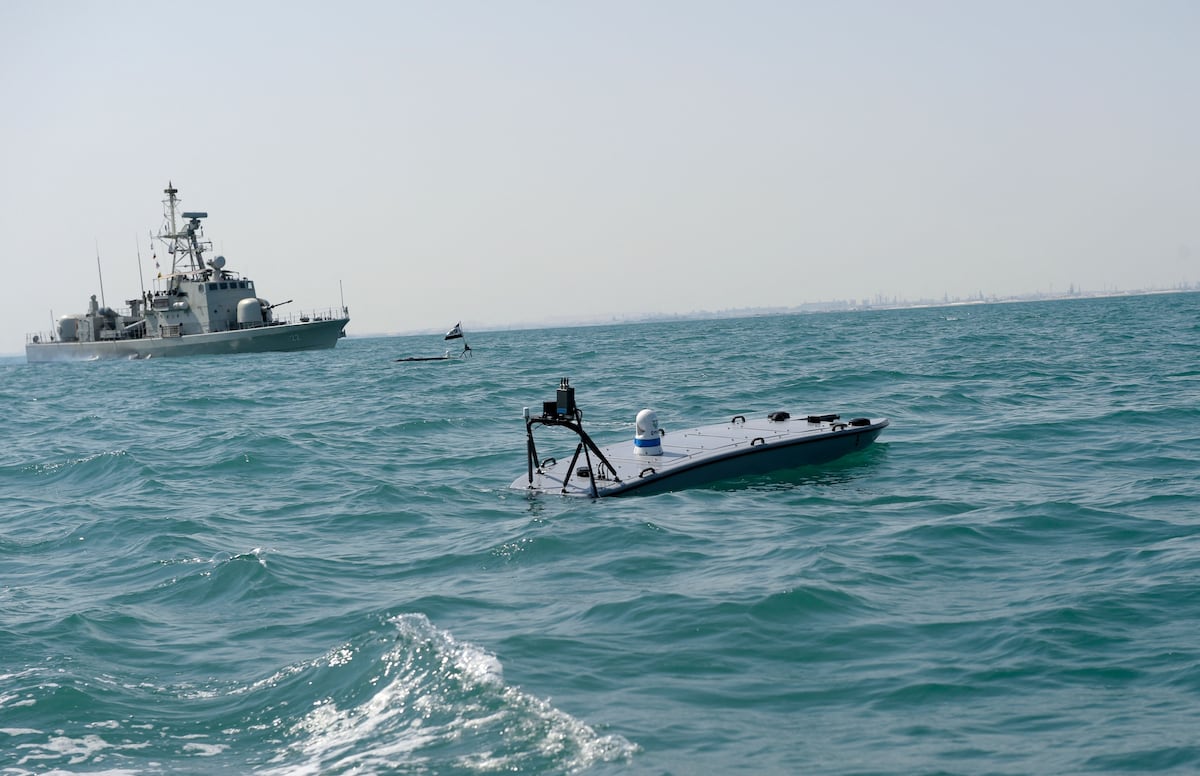
ABU DHABI, United Arab Emirates — All Gulf Cooperation Council countries plan to expand the multinational fleet of unmanned surface vessels in the Middle East, possibly tripling their situational awareness in countering drug and arms trafficking, according to a top U.S. Navy commander in the region.
At a news conference last month, Vice Adm. Brad Cooper, who oversees U.S. Naval Forces Central Command, commended the full and active participation of all six GCC states in increasing the patrol units of maritime drones. The council’s members are Kuwait, Saudi Arabia, Bahrain, the United Arab Emirates, Qatar and Oman.
“Bahrain and Kuwait have publicly committed to acquiring these systems. Every other country in the region is to some degree along that path of [further] acquisition,” Cooper said. “If you’re a country in the region that can see 20 miles off the coast, given the existing sensors and ships that they have, you can imagine what could be achieved by [employing more] USVs with radars and additional optics. You could see 60 miles, essentially tripling your domain awareness on any given day.”
Such an increase would enable GCC members to surveil more of the waters of the Persian Gulf, with Iran situated on the other side at varying distances between 35 miles at the narrowest point and 200 miles at the widest.
U.S. naval officials last year proclaimed the goal of creating an unmanned fleet of 100 platforms by the end of 2023. Regional and international partners are envisioned to contribute systems to the notional fleet, the thinking goes.
At the briefing, Cooper further emphasized a growing trend in illicit drug and weapons trafficking by criminal and terrorist organizations. Over the course of only two months, five major seizures at sea conducted by U.S. and allied maritime forces resulted in the capture of more than 5,000 weapons, 1.6 million rounds of ammunition, $60 million worth of illegal drugs, 7,000 proximity fuses for rockets and 2,000 kilograms of propellant used for rocket-propelled grenades, he said.
In addition, the Middle East also faces a high degree of oil and gas traffic at sea, which USVs can help protect.
“These threats require a type of platform that can conduct maritime surveillance, find and identify targets while also gathering data without colliding with other vessels,” Adam Watters, program manager for maritime domain awareness solutions at Saildrone told Defense News at the IDEX arms fair here last month.
The U.S. military has been experimenting for some time with the combination of artificial intelligence tools and long-endurance USVs to conduct these types of missions. One of the systems under consideration is Saildrone’s 33-foot Voyager platform, most recently deployed in the U.S. Army’s 2023 AI-enabled target identification exercise, Scarlet Dragon.
Saildrone says that due to an increase in the demand for its services, it is scaling up the production of both the Voyager and the 65-foot Surveyor systems for the year ahead. The week prior to IDEX, two of Saildrone’s Explorer drones also sailed in the first unmanned vessel exercise in the Arabian Gulf between the US Navy and the UAE Navy.
Elisabeth Gosselin-Malo was a Europe correspondent for Defense News. She covers a wide range of topics related to military procurement and international security, and specializes in reporting on the aviation sector. She is based in Milan, Italy.
阿联酋阿布扎比——据该地区一位美国海军高级指挥官称,所有海湾合作委员会国家都计划扩大在中东的多国无人水面舰艇舰队,这可能会使他们在打击毒品和武器走私方面的态势感知能力提高两倍。
上个月的新闻发布会上,美国海军中央司令部司令布拉德·库珀中将赞扬了海湾合作委员会六个成员国积极全面地参与增加海上无人机巡逻部队。海湾合作委员会成员国包括科威特、沙特阿拉伯、巴林、阿拉伯联合酋长国、卡塔尔和阿曼。
库珀说:“巴林和科威特已公开承诺采购这些系统。该地区其他国家也在某种程度上走上了这条(进一步)采购之路。如果你所在的地区国家目前仅凭现有的传感器和舰艇就能探测到离岸20英里(约32公里)的范围,那么你可以想象一下,如果(部署更多)配备雷达和额外光学设备的无人水面艇,将会取得怎样的成就。你的探测范围将达到60英里(约97公里),相当于在任何一天都将你的态势感知能力提升了三倍。”
这样的增长将使海湾合作委员会成员国能够监视波斯湾更多的水域,伊朗位于波斯湾的另一侧,距离最窄处为 35 英里,最宽处为 200 英里。
美国海军官员去年宣布,目标是在 2023 年底前打造一支由 100 个平台组成的无人舰队。设想中,区域和国际合作伙伴将为这支假想舰队贡献系统。
在简报会上,库珀进一步强调了犯罪组织和恐怖组织非法贩运毒品和武器的趋势日益增长。他表示,仅两个月内,美国及其盟国海上部队就开展了五次重大缉毒行动,缴获了超过5000件武器、160万发子弹、价值6000万美元的非法毒品、7000枚火箭近炸引信以及2000公斤火箭推进剂。
此外,中东地区海上石油和天然气运输量也很大,无人水面艇可以帮助保护这些运输。
“这些威胁需要一种能够进行海上监视、发现和识别目标,同时还能收集数据而不与其他船只发生碰撞的平台,”Saildrone 海上领域感知解决方案项目经理 Adam Watters 上个月在 IDEX 武器展上告诉《防务新闻》。
美国军方一直在试验将人工智能工具与长航时无人水面艇相结合,以执行此类任务。正在考虑的系统之一是Saildrone公司33英尺长的Voyager平台,该平台最近一次部署是在美国陆军2023年人工智能目标识别演习“猩红巨龙”中。
Saildrone公司表示,由于对其服务的需求增加,公司将扩大Voyager和65英尺Surveyor系统的产量,以备来年之需。在IDEX国际防务展前一周,Saildrone公司的两艘Explorer无人机也参加了美国海军和阿联酋海军在阿拉伯湾举行的首次无人舰艇联合演习。
伊丽莎白·戈斯林-马洛曾任《防务新闻》欧洲通讯员。她的报道涵盖军事采购和国际安全等广泛领域,尤其擅长航空领域的报道。她常驻意大利米兰。