Pentagon seeks authority to transfer nuclear submarines to Australia五角大楼寻求授权将核潜艇移交给澳大利亚
The Pentagon has asked Congress to authorize three new AUKUS provisions, including the transfer of nuclear-powered submarines to Australia.
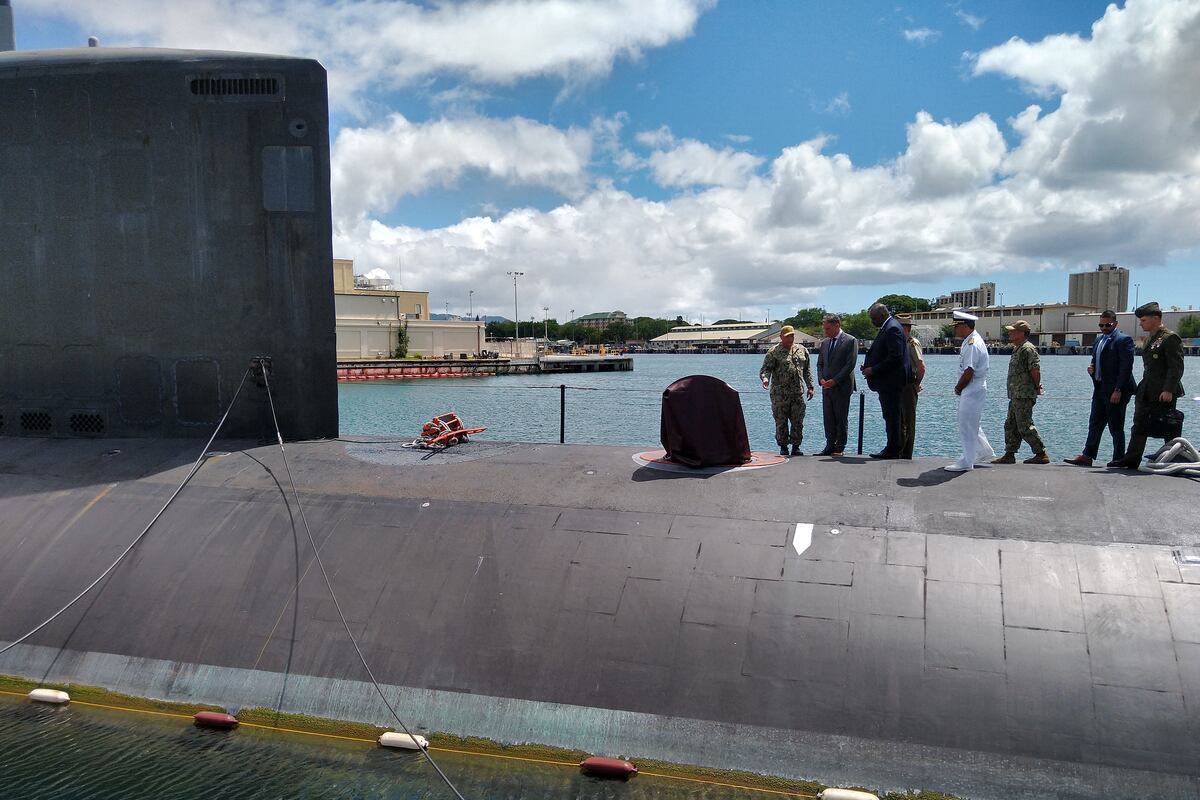
WASHINGTON — The U.S. Department of Defense asked Congress to authorize the transfer of nuclear-powered submarines to Australia as part of the trilateral AUKUS agreement with the U.K.
Three legislative proposals, submitted on May 2 and first posted online Tuesday, would greenlight the sale of two Virginia-class submarines to Australia, permit the training of Australian nationals for submarine work and allow Canberra to invest in the U.S. submarine industrial base.
Rep. Joe Courtney of Connecticut, the top Democrat on the Armed Services Committee’s sea power panel, praised the proposals in a statement to Defense News, saying “I look forward to working with all my colleagues in Congress to fulfill these goals.”
“The Department of Defense’s legislative proposals are the latest example of President [Joe] Biden’s commitment to fulfilling the AUKUS agreement,” said Courtney. “Importantly, the proposals spell out a clear path forward to facilitate the transfer of Virginia-class submarines to Australia while ensuring we have the necessary authorities to accept the Australian Government’s investments to enhance our submarine industrial base capacity and provide training for Australian personnel.”
AUKUS stipulates that Australia will buy at least three and as many as five Virginia-class submarines in the 2030s as part of phase two of the agreement, giving Congress more than a decade to authorize the sale. This year’s proposal, which the Pentagon hopes will become part of the fiscal 2024 National Defense Authorization Act, asks that Congress approve just two of those submarines “without a deadline to consummate the transfers and without specifying the specific vessels to be transferred.”
The proposal argues that this “small amount of flexibility is necessary” since the transfers depend on Australian readiness to operate the submarines, which will involve developing Australia’s submarine industrial base through training and appropriate shipyard infrastructure.
To that end, a second legislative proposal would authorize U.S. defense service exports directly to Australia’s private sector in order to train its own submarine workers.
“This development must begin as soon as possible for Australia to become ready to own and safely operate these submarines in a manner that both maintains the highest non-proliferation standards and strengthens the global non-proliferation regime,” the Pentagon argues in the proposal.
Finally, the Pentagon is also asking Congress for permission to accept Australian payments to bolster the U.S. submarine industrial base. Australia has offered to make an undisclosed sum of investments in the U.S. submarine industrial base as part of AUKUS .
The Pentagon states in the legislative proposal that those funds would be used to “add a significant number of trade workers” that will help address “the significant overhaul backlog” for the Virginia-class submarine. Australian monies would also be used for “advance purchasing of components and materials that are known to be replacement items for submarine overhauls” and “outsourcing less complex sustainment work to local contractors.”
Congress is also making its own investments to expand the U.S. submarine industrial base as the Navy ultimately aims to build two Virginia-class and one Columbia-class submarines per year. Courtney helped secure $541 million in submarine supplier development and $207 million in workforce development initiatives as part of the FY 23 government funding bill.
Austal USA, the American subsidiary of Australia-based Austal, plans to open a new facility at its shipyard in Mobile, Alabama to begin construction on nuclear submarine modules for General Dynamics’ Electric Boat shipyard in Connecticut, which produces both Virginia and Columbia-class submarines. Austal expects it will need 1,000 new hires in Mobile to staff that facility.
At Electric Boat, the prime contractor for the Virginia- and Columbia-class submarine programs, the hiring need will be even greater. The company currently employs more than 19,000 people, after hiring 3,700 new workers in 2022, according to local newspaper The Day . But the company needs to hire 5,750 new workers this year, to manage attrition and to help grow the workforce to about 22,000 to handle the increased workload.
The legislative proposal notes that Australian funds “would be applied to recruitment, training, incentivizing, and retention of key skilled trades, engineering and planning personnel in both nuclear and non-nuclear disciplines that are required by the additional AUKUS workload.”
Bryant Harris is the Congress reporter for Defense News. He has covered U.S. foreign policy, national security, international affairs and politics in Washington since 2014. He has also written for Foreign Policy, Al-Monitor, Al Jazeera English and IPS News.
Megan Eckstein is the naval warfare reporter at Defense News. She has covered military news since 2009, with a focus on U.S. Navy and Marine Corps operations, acquisition programs and budgets. She has reported from four geographic fleets and is happiest when she’s filing stories from a ship. Megan is a University of Maryland alumna.
华盛顿——美国国防部已请求国会授权向澳大利亚转让核动力潜艇,这是与英国签署的三方奥库斯协议的一部分。
5月2日提交的三项立法提案,于周二首次在网上发布,将批准向澳大利亚出售两艘弗吉尼亚级潜艇,允许对澳大利亚国民进行潜艇工作培训,并允许堪培拉投资美国潜艇工业基地。
康涅狄格州众议员乔·考特尼是众议院军事委员会海权小组的首席民主党议员,他在给《防务新闻》的一份声明中对这些提议表示赞赏,他说:“我期待与国会的所有同事合作,实现这些目标。”
“国防部的立法提案是拜登总统致力于履行奥库斯协议的最新例证,”考特尼说。“重要的是,这些提案明确指明了向澳大利亚移交弗吉尼亚级潜艇的途径,同时确保我们拥有必要的授权,接受澳大利亚政府的投资,以提升我们的潜艇工业基础能力,并为澳大利亚人员提供培训。”
根据《奥库斯协议》,澳大利亚将在2030年代购买至少三艘、至多五艘弗吉尼亚级潜艇,作为该协议第二阶段的一部分,并给予国会十多年的时间来批准这笔交易。五角大楼希望今年的提案能够纳入2024财年国防授权法案,该提案要求国会仅批准购买其中两艘潜艇,“不设定完成交付的最后期限,也不具体说明将要交付哪些潜艇”。
该提案认为,这种“少量的灵活性是必要的”,因为转让取决于澳大利亚操作潜艇的准备情况,而这将涉及通过培训和适当的造船厂基础设施来发展澳大利亚的潜艇工业基础。
为此,第二项立法提案将授权美国国防服务直接出口到澳大利亚私营部门,以便培训其自身的潜艇工作人员。
五角大楼在提案中辩称:“澳大利亚必须尽快开始这项研发工作,以便做好准备,拥有并安全操作这些潜艇,从而既保持最高的防扩散标准,又加强全球防扩散机制。”
最后,五角大楼还请求国会批准接受澳大利亚的款项,以加强美国的潜艇工业基础。澳大利亚已提出作为“奥库斯计划”(AUKUS)的一部分,向美国潜艇工业基础投资一笔未公开数额的资金。
五角大楼在立法提案中指出,这些资金将用于“增加大量技术工人”,以帮助解决弗吉尼亚级潜艇“严重的维修积压问题”。澳大利亚的资金还将用于“提前采购已知是潜艇维修更换部件的零部件和材料”,以及“将一些不太复杂的维护工作外包给当地承包商”。
国会也在加大投资,以扩大美国潜艇工业基础,因为海军的最终目标是每年建造两艘弗吉尼亚级潜艇和一艘哥伦比亚级潜艇。作为2023财年政府拨款法案的一部分,考特尼促成了5.41亿美元用于潜艇供应商发展,以及2.07亿美元用于劳动力发展计划。
澳大利亚奥斯塔公司(Austal)的美国子公司奥斯塔美国公司(Austal USA)计划在其位于阿拉巴马州莫比尔的造船厂开设一家新工厂,开始为通用动力公司位于康涅狄格州的电船造船厂建造核潜艇模块。电船造船厂生产弗吉尼亚级和哥伦比亚级潜艇。奥斯塔预计,该工厂需要莫比尔工厂新增1000名员工。
作为弗吉尼亚级和哥伦比亚级潜艇项目的总承包商,通用动力电船公司(Electric Boat)的招聘需求将更加迫切。据当地报纸《每日新闻》(The Day)报道,该公司目前拥有超过19000名员工,其中2022年新增了3700名。但为了应对人员流失并将员工总数扩充至约22000人以应对日益增长的工作量,该公司今年还需要招聘5750名新员工。
该立法提案指出,澳大利亚的资金“将用于招聘、培训、激励和留住核能和非核能领域的关键技术工人、工程和规划人员,以满足 AUKUS 额外工作量的需求。”
布莱恩特·哈里斯是《防务新闻》的国会记者。自2014年以来,他一直在华盛顿报道美国外交政策、国家安全、国际事务和政治。他还曾为《外交政策》、《Al-Monitor》、《半岛电视台英语频道》和IPS新闻撰稿。
梅根·埃克斯坦是《防务新闻》的海军作战记者。自2009年以来,她一直从事军事新闻报道,主要关注美国海军和海军陆战队的行动、采购项目和预算。她曾报道过四个不同地理区域的舰队,最喜欢在舰艇上进行新闻报道。梅根毕业于马里兰大学。