After meetings on Russia-Ukraine war, major obstacles to peace remain俄乌战争会谈结束后,和平进程仍面临重大障碍。
There was little concrete progress Monday on the obstacles to ending the war — a deadlock that likely favors Russian President Vladimir Putin.
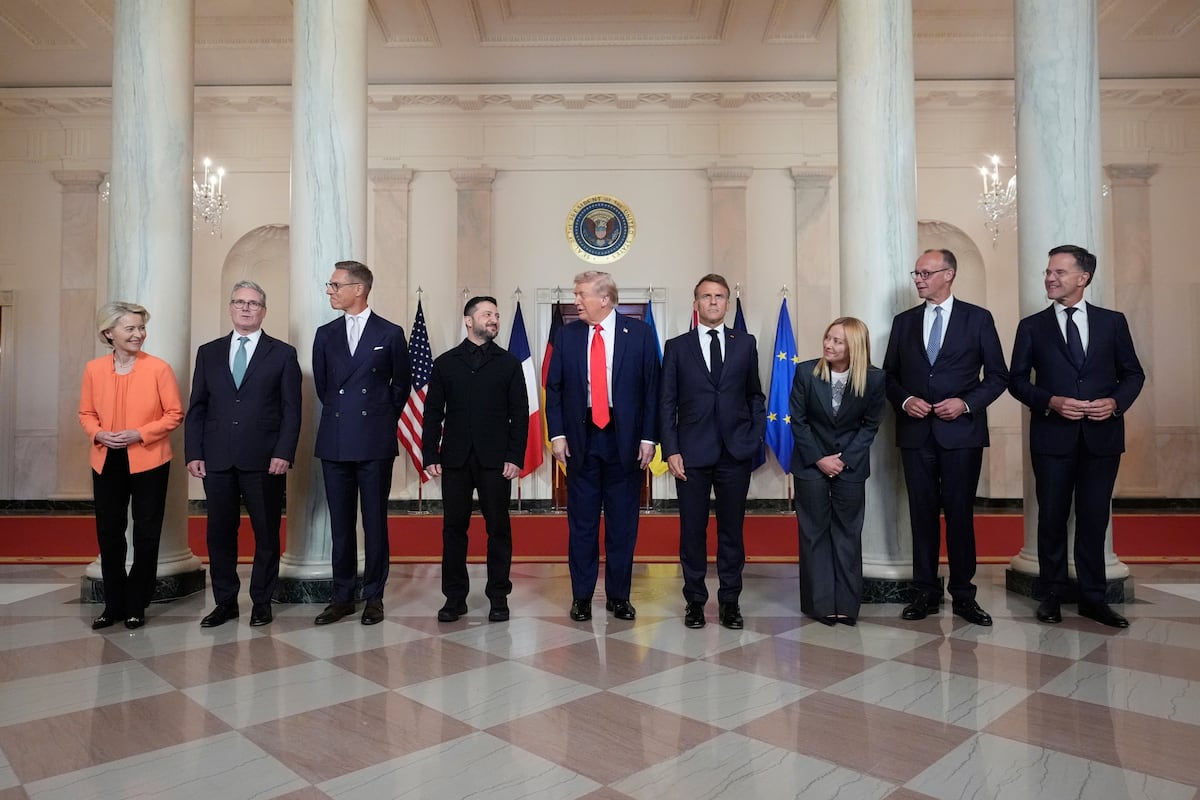
The second Oval Office meeting in six months between U.S. President Donald Trump and Ukrainian President Volodymyr Zelenskyy went off smoothly Monday, in sharp contrast to their disastrous encounter in February.
European leaders joined the discussions in a show of transatlantic unity, and both they and Zelenskyy repeatedly thanked Trump for his efforts to end Russia’s three-year war on Ukraine.
“I don’t want to hide the fact that I wasn’t sure it would go this way,” German Chancellor Friedrich Merz said in Washington. “But my expectations were not just met, they were exceeded.”
Zelenskyy said Tuesday: “We have taken an important step towards ending this war and ensuring security for Ukraine and all of Europe.”
But despite the guarded optimism and friendly banter among the leaders, there was little concrete progress on the main obstacles to ending the war — and that deadlock likely favors Russian President Vladimir Putin, whose forces continue to make steady, if slow progress on the ground in Ukraine.
“Putin cannot get enough champagne or whatever he’s drinking,” Gabrielius Landsbergis, a former foreign minister of Lithuania, said of Monday’s meeting.
As NATO Secretary-General Mark Rutte told The Ingraham Angle on Fox News: “All the details have to be hammered out.”
Here is a look at the issues that must be resolved:
Security guarantees for Ukraine
To agree to a peace deal with Russia, Ukraine wants assurances that it can deter any future attacks by the Kremlin’s forces.
That means, Zelenskyy says, a strong Ukrainian army that is provided with weapons and training by Western partners .
It could potentially also mean offering Ukraine a guarantee resembling NATO’s collective defense mandate, which sees an attack on one member of the alliance as an attack on all. How that would work is not clear.
Additionally, Kyiv’s European allies are looking to set up a force that could backstop any peace agreement in Ukraine.
A coalition of 30 countries, including European nations, Japan and Australia, have signed up to support the initiative, although the role that the U.S. might play in such a force is unclear.
European leaders, fearing Moscow’s territorial ambitions won’t stop in Ukraine, are keen to lock America’s military might into the plan.
Trump said he’ll help provide protection but stopped short of committing American troops to the effort, instead promising U.S. “coordination.”
Russia has repeatedly rejected the idea of such a force, saying that it will not accept NATO troops in Ukraine.
British Prime Minister Keir Starmer and French President Emmanuel Macron co-chaired an online meeting Tuesday of the coalition countries.
Once officials have discussed proposals in more detail, Rutte said, a virtual meeting will take place with Trump and European leaders.
Agreeing on a ceasefire
Ukraine and its European supporters have repeatedly called for a ceasefire while peace talks are held.
Putin has balked at that prospect. With his forces inching forward in Ukraine, he has little incentive to freeze their movement.
Ahead of his meeting with the Russian leader last week , Trump threatened Russia with “severe consequences” if it didn’t accept a ceasefire. Afterward, he dropped that demand and said it was best to focus on a comprehensive peace deal — as Putin has pushed for.
Trump said in Monday’s Oval Office meeting with Zelenskyy that a ceasefire between Russia and Ukraine was “unnecessary.” But after his closed-door meeting with European leaders and Zelenskyy, Trump told reporters that “all of us would obviously prefer the immediate ceasefire while we work on a lasting peace.”
Where Trump ultimately falls on that issue is important because it could affect how much Ukrainian land Russia has seized by the time the two sides get around to hammering out how much it could keep.
In this photo provided by Ukraine's 65th Mechanized Brigade press service, recruits practice military skills on a training ground on a sunflower field in the Zaporizhzhia region, Ukraine, Monday, Aug. 11, 2025, (Andriy Andriyenko/Ukraine's 65th Mechanized Brigade via AP)
Occupied Ukrainian territory
Zelenskyy and European leaders said that Putin has demanded that Ukraine give up the Donbas, an industrial region in eastern Ukraine that has seen some of the most intense fighting but that Russian forces have failed to capture completely.
Moscow’s forces also hold Crimea as well as parts of six other regions — all adding up to about one-fifth of Ukraine.
Zelenskyy has long noted the Ukrainian Constitution prohibits breaking up his country. He has also suggested the demand for territory would serve as a springboard for future invasion.
Rutte said the possibility of Ukraine ceding occupied territory to Russia in return for peace wasn’t discussed in Monday’s talks. That is an issue for Zelenskyy and Putin to consider together, he said to Fox News.
A Putin-Zelenskyy meeting
Zelenskyy has repeatedly suggested sitting down with Putin, even challenging the Russian leader to meet him as part of direct peace talks between the two sides in Turkey in May. Putin snubbed that offer, saying that significant progress on an agreement would have to be made before the pair met in person.
On Monday, Trump appeared to back Zelenskyy’s plan. “I called President Putin, and began the arrangements for a meeting, at a location to be determined, between President Putin and President Zelenskyy,” Trump said in a social media post.
He said he would join the two leaders afterward.
But when discussing a phone call held after the meeting between Trump and the Russian leader, Putin’s foreign affairs adviser Yuri Ushakov gave no indication that either a bilateral or a trilateral meeting with Ukraine had been agreed.
European leaders know that Putin doesn’t want to meet Zelenskyy and that he won’t allow Western troops in Ukraine — but they’re expressing optimism that these things could happen in the hopes of forcing Putin to be the one to say no to Trump, according to Janis Kluge of the German Institute for International and Security Affairs.
“Europeans hype up expectations to create a reality in which Putin disappoints,” he wrote on X.
Associated Press writers Sam McNeil in Brussels and Emma Burrows in London contributed.
美国总统唐纳德·特朗普和乌克兰总统弗拉基米尔·泽连斯基六个月来的第二次椭圆形办公室会晤于周一顺利举行,与他们二月份灾难性的会晤形成了鲜明对比。
欧洲领导人也参与了讨论,展现了跨大西洋的团结。他们和泽连斯基都多次感谢特朗普为结束俄罗斯对乌克兰长达三年的战争所做的努力。
德国总理弗里德里希·默茨在华盛顿表示:“我并不否认,我一开始并不确定事情会朝着这个方向发展。但我的预期不仅得到了满足,而且还超出了预期。”
泽连斯基周二表示:“我们朝着结束这场战争、确保乌克兰和整个欧洲的安全迈出了重要一步。”
尽管领导人之间保持着谨慎的乐观态度和友好的玩笑,但在结束战争的主要障碍方面却鲜有实质性进展——这种僵局可能对俄罗斯总统弗拉基米尔·普京有利,他的军队在乌克兰地面上继续稳步推进,尽管进展缓慢。
“普京对香槟或其他什么饮料都喝不够,”立陶宛前外交部长加布里埃柳斯·兰茨贝吉斯在谈到周一的会晤时说道。
正如北约秘书长马克·吕特在福克斯新闻的《英格拉汉姆视角》节目中所说:“所有细节都必须敲定。”
以下是需要解决的问题:
乌克兰的安全保障
乌克兰若想与俄罗斯达成和平协议,希望得到保证,能够阻止克里姆林宫军队未来的任何袭击。
泽连斯基表示,这意味着一支强大的乌克兰军队,其武器和训练都由西方伙伴提供。
这也可能意味着向乌克兰提供类似于北约集体防御授权的保障,即对联盟任何一个成员国的攻击都等同于对所有成员国的攻击。但具体如何操作尚不清楚。
此外,基辅的欧洲盟友正寻求组建一支部队,以支持乌克兰的任何和平协议。
包括欧洲国家、日本和澳大利亚在内的 30 个国家组成的联盟已签署协议支持该倡议,但美国可能在该联盟中扮演的角色尚不明确。
欧洲领导人担心莫斯科的领土野心不会止步于乌克兰,因此急于将美国的军事力量纳入该计划。
特朗普表示他将帮助提供保护,但并未承诺派遣美军参与这项工作,而是承诺美国将进行“协调”。
俄罗斯一再拒绝组建这样一支部队的想法,并表示不会接受北约军队进驻乌克兰。
英国首相基尔·斯塔默和法国总统埃马纽埃尔·马克龙周二共同主持了联合政府国家的线上会议。
吕特表示,官员们详细讨论提案后,将与特朗普和欧洲领导人举行一次线上会议。
同意停火
乌克兰及其欧洲支持者多次呼吁在和平谈判期间停火。
普京对这种前景感到担忧。随着他的军队在乌克兰步步推进,他几乎没有理由阻止他们的行动。
在上周与俄罗斯领导人会晤前,特朗普威胁俄罗斯,如果俄罗斯不接受停火,将面临“严重后果”。会后,他放弃了这一要求,并表示最好集中精力达成一项全面的和平协议——正如普京一直敦促的那样。
特朗普周一在椭圆形办公室与泽连斯基会晤时表示,俄罗斯和乌克兰之间停火“没有必要”。但在与欧洲领导人和泽连斯基举行闭门会议后,特朗普告诉记者,“我们所有人显然都希望立即停火,同时努力实现持久和平。”
特朗普最终在这个问题上的立场很重要,因为这可能会影响到双方最终敲定俄罗斯可以保留多少乌克兰土地时,俄罗斯已经占领了多少乌克兰土地。
这张由乌克兰第65机械化旅新闻处提供的照片显示,2025年8月11日星期一,在乌克兰扎波罗热州的一片向日葵田中,新兵们正在训练场上练习军事技能。(Andriy Andriyenko/乌克兰第65机械化旅 via AP)
被占领的乌克兰领土
泽连斯基和欧洲领导人表示,普京要求乌克兰放弃顿巴斯地区。顿巴斯是乌克兰东部的一个工业区,曾发生过一些最激烈的战斗,但俄罗斯军队未能完全占领该地区。
莫斯科的军队还占领了克里米亚以及其他六个地区的部分地区——所有这些加起来约占乌克兰领土的五分之一。
泽连斯基长期以来一直指出,乌克兰宪法禁止分裂他的国家。他还暗示,对领土的要求将成为未来入侵的跳板。
吕特表示,周一的会谈并未讨论乌克兰以割让被占领土换取和平的可能性。他对福克斯新闻说,这是泽连斯基和普京需要共同考虑的问题。
普京-泽连斯基会晤
泽连斯基曾多次提议与普京会面,甚至挑战普京在5月于土耳其举行的双方直接和平谈判中与他会面。普京拒绝了这一提议,称双方必须在达成协议方面取得实质性进展,才能举行会晤。
周一,特朗普似乎支持泽连斯基的计划。特朗普在社交媒体上发帖称:“我给普京总统打了电话,开始安排普京总统和泽连斯基总统在待定地点会面。”
他说之后会与两位领导人会合。
但普京的外交事务顾问尤里·乌沙科夫在谈到特朗普与俄罗斯领导人会晤后进行的一次电话通话时,并未表示已同意与乌克兰举行双边或三边会晤。
据德国国际与安全事务研究所的雅尼斯·克鲁格称,欧洲领导人知道普京不想与泽连斯基会面,也不会允许西方军队进入乌克兰——但他们仍然乐观地认为这些事情可能会发生,希望以此迫使普京对特朗普说“不”。
“欧洲人夸大期望,制造出普京令人失望的现实,”他在 X 上写道。
美联社驻布鲁塞尔记者萨姆·麦克尼尔和驻伦敦记者艾玛·伯罗斯对此文亦有贡献。