Turkey seeks partners for TF-X fighter program amid fiscal uncertainty在财政不确定性加剧的情况下,土耳其寻求TF-X战斗机项目的合作伙伴。
The Turkish economy is experiencing high inflation, and the country’s external debt reached nearly $476 billion in March.
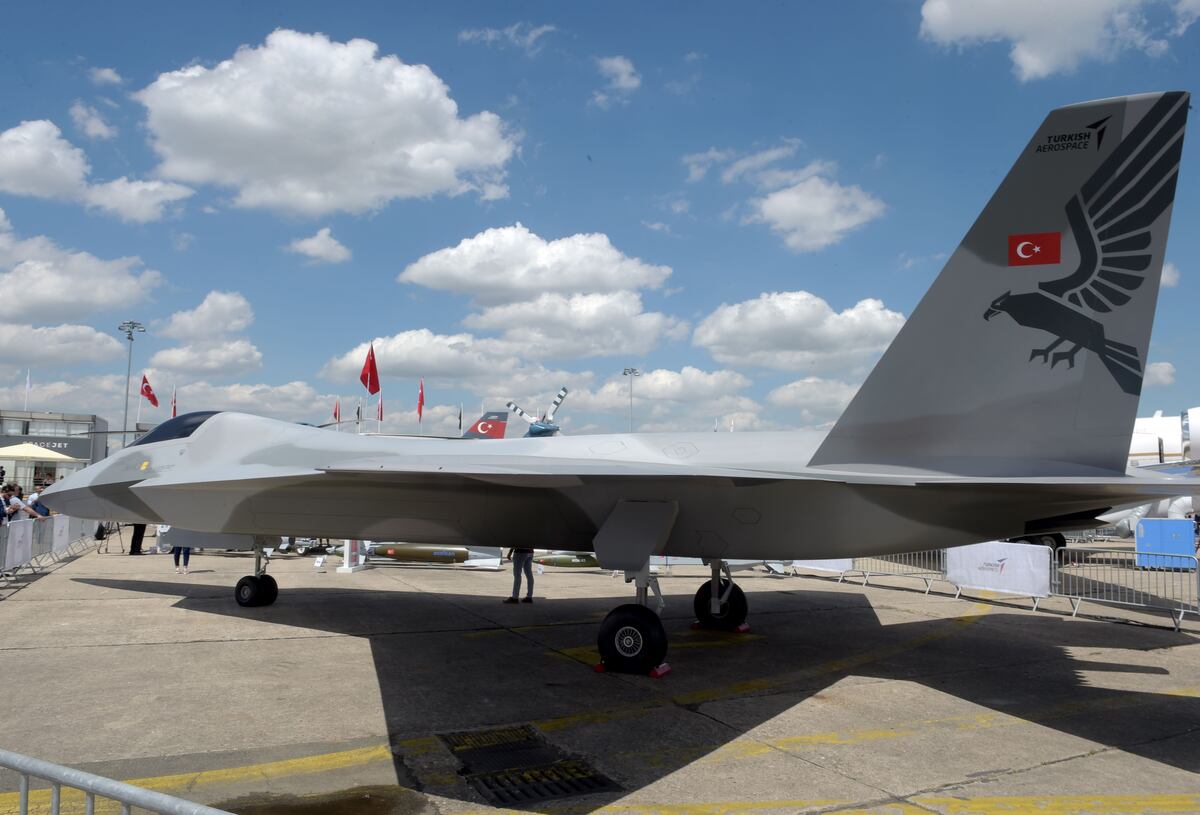
ANKARA, Turkey — The first aircraft of Turkey’s indigenous fighter program, the TF-X, sits in a hangar ahead of its maiden flight at the end of the year. But fiscal problems could stand in the way of its success, according to an analyst, even as the country’s president seeks partners for the program.
The Turkish economy is experiencing high inflation, and the country’s external debt reached nearly $476 billion in March. The international insurance company Allianz Trade reported the stock of total external debt due within the next 12 months has risen to about $250 billion.
“Inevitably, the TF-X program will face financial difficulties in line with the country’s economic situation,” Ozgur Eksi, a defense analyst in Ankara, told Defense News.
However, Turkey is seeking foreign partners , which could lessen its own financial burden in regard to the program.
Turkish Defence Minister Yasar Guler said Aug. 14 Pakistan was about to sign an agreement to participate in the development of the fifth-generation fighter. “Friendly and brotherly countries are also making efforts to become partners in this project. An agreement was signed with Azerbaijan. There are other countries that are also about to sign, like Pakistan,” Guler said.
If Pakistan joins the Turkish program, it would be its second international fighter partnership following a deal with China on the JF-17 built by Pakistan Aeronautical Complex and Chengdu Aircraft Corp.
As for Azerbaijan, the government there signed a protocol with Turkey to explore involvement in the TF-X program.
“With the protocol, it is aimed to determine the working procedures and principles of cooperation with Azerbaijan on joint production issues, including the development activities of the 5th-generation national combat aircraft Kaan, which is being developed for the Turkish Air Force,” according to the Turkish Defence Industry Agency, using the government’s chosen name for the TF-X aircraft.
The agency, otherwise known as SSB, did not reply to Defense News’ questions on the TF-X and specifically Pakistan’s current status in relation to the program.
The Pakistan Air Force declined to comment on the status.
“Getting in foreign partners is like subletting part of your house: You share expenses, but disputes become inevitable and troubleshooting takes much longer than normal,” Eksi said. “Hydrocarbon-rich Azerbaijan has money. Pakistan does not but could transfer know-how. Once combat-proven, the Kaan could be an option for countries without access to Western-made fighter aircraft.”
Eugene Kogan, a defense analyst based in Tbilisi, Georgia, said Azerbaijan appears ready to bring money to the table.
“As for Pakistan, I wonder what exactly it can bring to the table. Not money, obviously. Technological know-how? More questions than answers,” he told Defense News.
The government wants to fly the planned aircraft this year, the centennial of the Turkish republic. Turkish Aerospace Industries said the TF-X will fly Dec. 27, 2023.
Under the program, TAI will deliver 20 TF-X Block 10 aircraft to the Air Force in 2028. The company said in March the per-unit price will be $100 million, but noted in May it could be “ a little bit higher .” By 2029, TAI plans to produce two TF-X fighters per month, generating an annual revenue of $2.4 billion.
Concept art of the TF-X, or Kaan, aircraft. (Turkish Aerospace Industries)
“In all probability, the aircraft will fly for political purposes before critical local elections [in March] but without most systems fitted into it,” a program insider told Defense News on the condition of anonymity, fearing prosecution for discussing the subject. “Most Turks will not know or care if the aircraft is ready for any mission. It will be a piece in [the] government’s showoff.”
Turkey launched the TF-X program in 2009. In October 2016, British firm Rolls-Royce offered a joint production partnership to Turkey with a view to powering planned Turkish platforms and potential sales to third parties. The company’s proposal, which still stands, would see a production unit in Turkey manufacture engines for the TF-X as well as helicopters, tanks and missiles.
In January 2017, the British company BAE Systems and TAI signed a deal worth more than £100 million (U.S. $127 million) to develop the Turkish fighter jet. Presently there are about 30 BAE engineers working at the TAI production unit for the TF-X.
Then in 2022, the Turkish government launched a competition for the local development of a turbofan engine to power the TF-X. Three competitors are in the running: Tusas Engine Industries; TRMotor; and TAEC , a joint venture between Rolls-Royce and Turkish industrial conglomerate Kale, which owns 51% of TAEC.
TAEC has pitched an engine expected to fly the aircraft at a maximum altitude of 40,000 feet and help it reach a speed of up to Mach 1.8.
It’s unclear what TRMotor is offering. The company was founded in 2017 by SSTEK, a subsidiary of SSB. Tusas, which is the parent company of Tusas Engine Industries and Turkish Aerospace Industries, wholly owns TRMotor.
Tusas Engine Industries is developing TEI-TF6000 and TEI-TF10000 engines, referring to them as a prelude to what it will produce for the TF-X. TEI is a government-controlled business founded in 1985 as a joint venture involving the American firm GE Aviation (now GE Aerospace), Turkish Aerospace Industries, the Turkish Aeronautical Association, and the government-owned Turkish Armed Forces Foundation.
SSB plans to build TF-X prototypes using the American-made F110 engine. The General Electric F110 is an afterburning turbofan jet engine produced by GE Aerospace, and it uses the same engine core design as the company’s F101. The engine is also built under license by Tusas Engine Industries.
A U.S. airman checks an F110 engine after a test run. Turkey plans to build TF-X prototypes using the American-made system. (Tech. Sgt. Matt Hecht/U.S. Air Force)
Turkey wants to use the F110 in serial production, but powering the TF-X with the engine may prove difficult because serial production could require vast amounts of investment and tests. Furthermore, this option would come with the same export license and intellectual property rights as Rolls-Royce’s offer, which the Turkish government dislikes.
Eksi said the government shouldn’t delay its engine choice any longer.
“Every [engine] proposal has advantages and disadvantages. Ankara must make a decision at once before it’s too late to move onto the serial production phase at feasible costs,” he explained.
Ultimately, the TF-X’s export potential is key to the program’s success, Eksi added.
“There are several countries that cannot buy Western-made aircraft for political reasons. Some of those countries also want to avoid Russian- or Chinese-made aircraft, also for political reasons. The Kaan could be what they’re looking for.”
Usman Ansari in Islamabad contributed to this report.
Burak Ege Bekdil was the Turkey correspondent for Defense News.
土耳其安卡拉——土耳其国产战斗机项目TF-X的首架飞机停放在机库中,等待年底的首飞。但据一位分析人士称,尽管土耳其总统正在为该项目寻求合作伙伴,但财政问题仍可能阻碍其成功。
土耳其经济正经历高通胀,该国外债在3月份接近4760亿美元。国际保险公司安联贸易报告称,未来12个月内到期的外债总额已升至约2500亿美元。
“不可避免地,TF-X计划将面临与国家经济状况相符的财政困难,”安卡拉的国防分析师奥兹古尔·埃克西告诉《防务新闻》。
然而,土耳其正在寻求外国合作伙伴,这可以减轻其在该计划方面的财政负担。
土耳其国防部长亚沙尔·居莱尔8月14日表示,巴基斯坦即将签署一项协议,参与第五代战斗机的研发。“友好兄弟国家也在努力成为该项目的合作伙伴。我们已经与阿塞拜疆签署了协议。还有其他一些国家,比如巴基斯坦,也即将签署协议。”居莱尔说。
如果巴基斯坦加入土耳其的战斗机项目,这将是继与中国就巴基斯坦航空工业集团和成都飞机工业集团联合研制的JF-17战斗机达成协议之后,巴基斯坦的第二个国际战斗机合作项目。
至于阿塞拜疆,该国政府与土耳其签署了一项议定书,探讨参与 TF-X 计划的可能性。
据土耳其国防工业局称,“该协议旨在确定与阿塞拜疆在联合生产问题上的合作工作程序和原则,包括为土耳其空军开发的第五代国产战斗机‘卡安’的研发活动。”这里使用的是政府为TF-X飞机选定的名称。
该机构,又称 SSB,没有回复《防务新闻》关于 TF-X 以及巴基斯坦目前在该计划中的地位的问题。
巴基斯坦空军拒绝就此事发表评论。
埃克西说:“引入外国合作伙伴就像把房子的一部分转租出去:你们分担费用,但纠纷在所难免,解决问题所需的时间也比正常情况长得多。阿塞拜疆拥有丰富的油气资源,资金雄厚。巴基斯坦没有资金,但可以转让技术。一旦经过实战检验,卡安战斗机对于那些无法获得西方制造的战斗机的国家来说,可能是一个不错的选择。”
常驻格鲁吉亚第比利斯的国防分析师尤金·科根表示,阿塞拜疆似乎准备拿出资金。
“至于巴基斯坦,我很好奇它究竟能带来什么。显然不是资金。技术诀窍呢?问题比答案还多,”他告诉《防务新闻》。
土耳其政府希望在今年,即土耳其共和国成立一百周年之际,试飞这架计划中的飞机。土耳其航空航天工业公司表示,TF-X飞机将于2023年12月27日首飞。
根据该计划,TAI将于2028年向美国空军交付20架TF-X Block 10战斗机。该公司3月份表示,单价为1亿美元,但5月份又指出价格可能会“略高一些”。到2029年,TAI计划每月生产两架TF-X战斗机,年收入将达到24亿美元。
TF-X(又称 Kaan)飞机的概念图。(土耳其航空航天工业公司)
一位项目内部人士匿名告诉《防务新闻》:“这架飞机很可能会在关键的地方选举(3月)前用于政治目的,但大部分系统尚未安装。”他担心讨论此事会遭到起诉。“大多数土耳其人不会知道,也不关心这架飞机是否准备好执行任何任务。它只不过是政府作秀的工具而已。”
土耳其于2009年启动了TF-X项目。2016年10月,英国劳斯莱斯公司向土耳其提出合作生产方案,旨在为土耳其计划中的平台提供动力,并可能向第三方销售。该公司提出的方案目前仍然有效,该方案将在土耳其设立生产基地,生产TF-X以及直升机、坦克和导弹的发动机。
2017年1月,英国BAE系统公司与土耳其航空航天工业公司(TAI)签署了一项价值超过1亿英镑(约合1.27亿美元)的协议,共同研发土耳其TF-X战斗机。目前,约有30名BAE工程师在TAI的生产部门参与TF-X战斗机的研发工作。
随后在 2022 年,土耳其政府启动了一项竞赛,旨在自主研发用于 TF-X 战斗机的涡扇发动机。共有三家公司参与竞标:Tusas Engine Industries;TRMotor;以及 TAEC,后者是劳斯莱斯和土耳其工业集团 Kale 的合资企业,Kale 持有 TAEC 51% 的股份。
TAEC 推出了一款发动机,预计可使飞机在 40,000 英尺的最大高度飞行,并帮助其达到高达 1.8 马赫的速度。
目前尚不清楚TRMotor的具体业务内容。该公司由SSB的子公司SSTEK于2017年创立。TRMotor的母公司为Tusas,后者旗下拥有Tusas发动机工业公司和土耳其航空航天工业公司。
土耳其发动机工业公司(Tusas Engine Industries)正在研发TEI-TF6000和TEI-TF10000发动机,并称其为未来TF-X战斗机发动机的先导。TEI是一家政府控股企业,成立于1985年,是由美国通用电气航空集团(现为通用电气航空航天集团)、土耳其航空航天工业公司、土耳其航空协会和土耳其武装部队基金会共同合资成立的。
SSB计划使用美国制造的F110发动机建造TF-X原型机。通用电气F110是一款由通用电气航空航天公司生产的带加力燃烧室的涡扇喷气发动机,其核心设计与该公司生产的F101发动机相同。该发动机也由图萨斯发动机工业公司获得许可生产。
一名美国空军士兵在试飞后检查F110发动机。土耳其计划使用美国制造的发动机系统建造TF-X原型机。(美国空军技术军士马特·赫克特/美国空军)
土耳其希望将F110发动机投入量产,但为TF-X飞机配备该发动机可能困难重重,因为量产需要巨额投资和大量测试。此外,该方案与劳斯莱斯的方案一样,都涉及出口许可证和知识产权,而土耳其政府对此并不满意。
埃克西表示,政府不应再拖延发动机的选择。
他解释说:“每项发动机方案都有其优缺点。安卡拉必须尽快做出决定,以免为时过晚,无法以可行的成本进入批量生产阶段。”
埃克西补充说,TF-X 的出口潜力最终是该项目成功的关键。
“有些国家出于政治原因无法购买西方制造的飞机。其中一些国家也出于政治原因想要避免购买俄罗斯或中国制造的飞机。卡安飞机或许正是他们所需要的。”
伊斯兰堡的乌斯曼·安萨里对本报道亦有贡献。
布拉克·埃格·贝克迪尔是《防务新闻》的土耳其记者。