Experts worry about nuclear quid pro quo in Russia-North Korea alliance against Ukraine专家担忧俄罗斯-朝鲜联盟可能以核交换条件对抗乌克兰
Analysts differ on the question of whether Moscow would trade away highly sensitive nuclear submarine technology in exchange for battlefield support.
BERLIN — With North Korean soldiers and equipment playing a key role at Russia’s front line in Ukraine, some experts worry Moscow may be ready to return the favor by providing highly sensitive information on nuclear submarines to its newfound ally in Pyongyang.
Russia could trade away what Peter Roberts, associate fellow at the University of Exeter’s Centre for Public Understanding of Defence and Security, described as the “crown jewels of military knowledge,” if Moscow runs out of things to offer Pyongyang in exchange for Kim Jong Un’s support.
Roberts was speaking as an expert before the U.K. Parliament during a Feb. 10 hearing on undersea activity.
North Korea’s role in Russia’s war against Ukraine has become vital for the Kremlin. According to South Korean intelligence, the North has suffered 6,000 casualties fighting for Russia. It is also supplying millions of artillery shells, ballistic missiles , and various types of vehicles and gear.
“It used to be that to get North Korean weapons or North Korean soldiers to fight in Ukraine for [Putin] ... he would trade away ballistic missile technology and knowledge. Well, he has done that − it has sort of gone,” Roberts told British lawmakers. “You are now starting to see what is potentially the leaching and offering of submarine expertise to states like North Korea and Iran in exchange for key capabilities, whether that is mass drone manufacturing or engineers being put to the frontline in Ukraine.”
This would represent a significant step in the military ties between the two countries and signal a level of desperation among Russian policy elites. According to Roberts, “previously, nuclear submarine operating knowledge was something you never shared. It was kept within a strictly confined group of people. These were the crown jewels of military knowledge.”
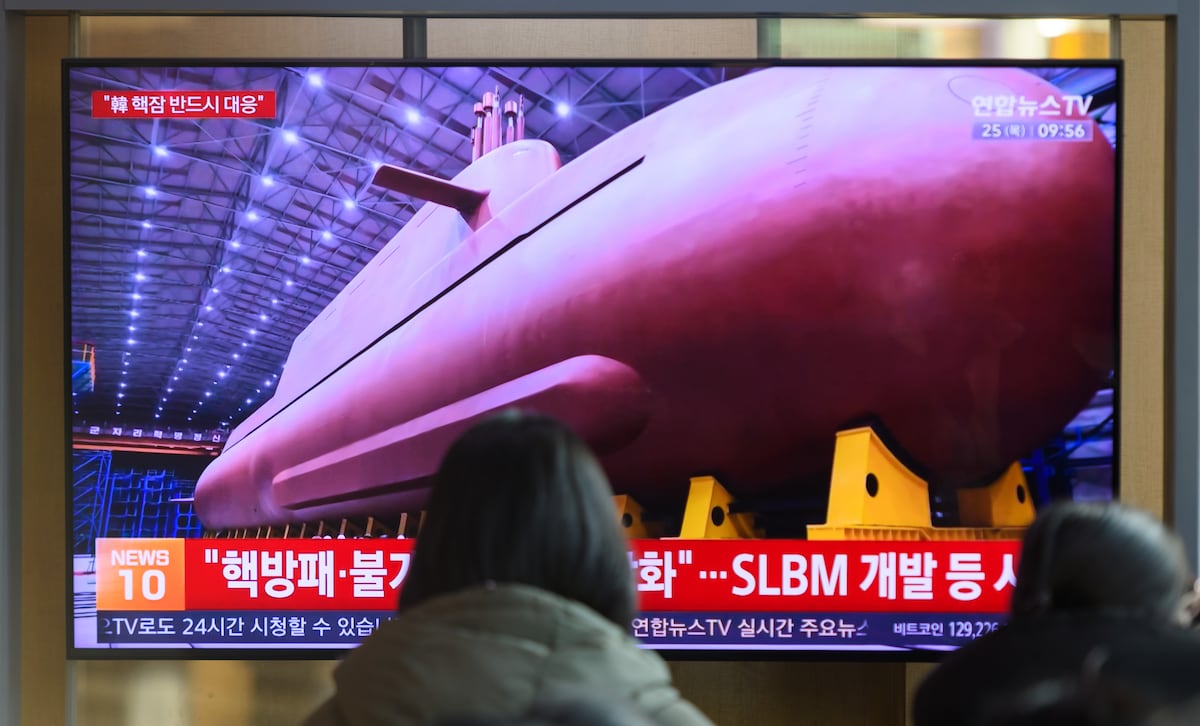
On Dec. 25, 2025, North Korean state media broadcast images of Kim Jong Un inspecting an “8,700-ton nuclear-powered strategic guided missile submarine” at the Sinpo shipyard — the most detailed look yet at a program Kim has prioritized since at least 2021. Seoul-based analysts noted that the fully assembled exterior suggested reactor installation was likely complete, with one former South Korean submarine officer estimating the vessel could be ready for sea trials within months.
“They’ve definitely been pursuing this for some time,” John Ford, a research associate at the California-based James Martin Center for Nonproliferation Studies, said of North Korean ambitions to develop a submarine component to its nuclear deterrence.
In an interview with Defense News, he said the regime is building what he called a “jank triad” − far from advanced, but sufficient to make any enemy think twice about whether to attack a country with a nuclear second strike capability that may work “well enough.”
In nuclear deterrence parlance, a country has completed a triad when it can launch nuclear weapons from land, air and sea.
North Korea has on several occasions shocked observers when it attained complex technological goals on its own that analysts thought would take many more years to figure out, such as producing a nuclear bomb, miniaturizing it, placing it atop a missile , and making progress toward a functioning re-entry vehicle.
“For subs, there’s a lot that can go wrong,” said Ford. “You’re basically taking all that previous stuff, and then you’re amplifying it − now it needs to be underwater.”
“The actual skill of operating underwater is something that they just don’t have. And unless Russian navy submariners are doing ride-alongs and training them, which I don’t think would be happening − even then, it would take a really long time,” said Ford.
But there are signs that North Korea’s leadership is getting its fair share out of the support for Putin’s war efforts. For one, Russian experts have been making repeated trips to the DPRK, though, due to the secrecy of both countries, few details are known about what they do there.
And in September 2025, South Korea’s military said it had obtained intelligence suggesting Russia supplied North Korea with two to three nuclear submarine propulsion modules − reportedly salvaged from decommissioned Russian submarines − including a reactor, turbine, and cooling system. Seoul said at the time it was working to verify the information.
However, Ford said he remains “very skeptical” that Russia has handed over the most sensitive elements of its submarine expertise
“Nuclear weapons designs: impossible,” Ford said. “Propulsion? More possible, but still very unlikely.”
Countries, as a rule, don’t trade their most closely held military knowledge, Ford noted. Russia has particular reasons for caution: intelligence transferred to North Korea could leak to Seoul via human intelligence networks, meaning Moscow would effectively be giving South Korea a window into its own reactor designs.
And even if Russia shared some information on how nuclear submarine propulsion works, North Korea would still need to bridge the gap between theoretical knowledge and practical implementation, something Ford notes took the Soviet Union and the U.S. decades to master during the Cold War.
There are also institutional barriers. “The people in Russia who are responsible for holding and maintaining this information will object to it being shared,” Ford said − although Putin ultimately has the authority to override them.
There is a difference between handing over the blueprints and providing more iterative tech support, such as answering questions or confirming whether components are correctly placed, as Ford says happened in previous proliferation cases, such as tacit U.S. assistance while France was developing its own nuclear weapons.
And Russia likely has more leverage in the relationship than popular reporting suggests. The primary compensation North Korea is receiving from Russia remains cash, Ford argues, which Pyongyang − isolated by some of the harshest UN sanctions ever imposed − has long been chronically short on. The government channels it into domestic development, from manufacturing capacity to infrastructure. Technical assistance from Russia, if it exists, is secondary and likely more constrained than the most alarmist assessments imply, said Ford.
What is not in dispute is the regime’s ambition. Kim has made the nuclear submarine a stated political priority, visited the Sinpo shipyard repeatedly, and invoked the language of a “nuclear shield.” At the country’s Yongbyon nuclear research center, Center for Nonproliferation Studies analysts have flagged new construction that may be a submarine reactor testbed.
Rudy Ruitenberg in Paris contributed to this story.
Linus Höller is Defense News' Europe correspondent and OSINT investigator. He reports on the arms deals, sanctions, and geopolitics shaping Europe and the world. He holds master’s degrees in WMD nonproliferation, terrorism studies, and international relations, and works in four languages: English, German, Russian, and Spanish.
柏林——由于朝鲜士兵和装备在俄罗斯乌克兰前线发挥着关键作用,一些专家担心莫斯科可能准备向其在平壤的新盟友提供有关核潜艇的高度敏感信息以示回报。
如果莫斯科没有东西可以提供给平壤以换取金正恩的支持,那么俄罗斯可能会出卖彼得·罗伯茨(埃克塞特大学国防与安全公共理解中心副研究员)所说的“军事知识的皇冠上的明珠”。
2月10日,罗伯茨作为专家在英国议会就海底活动举行的听证会上发表了讲话。
朝鲜在俄罗斯对乌克兰的战争中扮演的角色对克里姆林宫而言至关重要。据韩国情报部门称,朝鲜在为俄罗斯作战中已有6000人伤亡。此外,朝鲜还向俄罗斯提供了数百万枚炮弹、弹道导弹以及各种车辆和装备。
罗伯茨告诉英国议员:“过去,为了让朝鲜获得武器或士兵为普京在乌克兰作战,他会用弹道导弹技术和知识进行交换。现在,这种做法已经不再奏效了。”他接着说:“你们现在开始看到,普京可能正在向朝鲜和伊朗等国输送潜艇技术,以换取关键能力,无论是大规模生产无人机,还是将工程师派往乌克兰前线。”
这将标志着两国军事关系迈出重要一步,也表明俄罗斯政策精英们已陷入绝境。罗伯茨表示,“此前,核潜艇的操作知识是绝对不会外传的,它被严格限制在少数人手中,是军事知识的瑰宝。”
2025年12月25日,朝鲜官方媒体播放了金正恩在新浦造船厂视察一艘“8700吨级核动力战略导弹潜艇”的画面——这是迄今为止对金正恩自2021年以来一直优先推进的该项目最详细的展示。首尔的分析人士指出,潜艇外部已完全组装完毕,表明反应堆安装可能已经完成,一位韩国前潜艇军官估计,该潜艇可能在几个月内即可进行海上试航。
“他们肯定已经为此努力了一段时间了,”加州詹姆斯·马丁防扩散研究中心的研究员约翰·福特在谈到朝鲜发展潜艇以增强其核威慑能力的野心时说道。
他在接受《防务新闻》采访时表示,该政权正在构建他所谓的“蹩脚三位一体”——虽然远称不上先进,但足以让任何敌人三思而后行,考虑是否要攻击一个拥有核二次打击能力的国家,而这种能力可能“足够好用”。
在核威慑术语中,一个国家如果能够从陆地、空中和海上发射核武器,就完成了三位一体的核威慑。
朝鲜曾多次让观察家们感到震惊,因为它独立实现了分析人士认为还需要很多年才能实现的复杂技术目标,例如制造核弹、将其小型化、将其安装在导弹上以及在研制可用的再入飞行器方面取得进展。
福特说:“对于潜艇来说,有很多环节都可能出错。你基本上是把以前所有的问题都考虑进去,然后放大这些问题——现在它还得在水下。”
福特说:“他们根本不具备水下作业的实际技能。除非俄罗斯海军潜艇兵陪同他们进行训练,但我认为这不太可能发生——即便如此,也需要很长时间。”
但种种迹象表明,朝鲜领导层也从普京的战争行动中获得了相当的利益。例如,俄罗斯专家多次访问朝鲜,但由于两国都高度保密,外界对他们在朝鲜的活动知之甚少。
2025年9月,韩国军方表示,他们获得情报显示,俄罗斯向朝鲜提供了两到三个核潜艇推进模块——据称是从退役的俄罗斯潜艇上拆卸下来的——包括一个反应堆、涡轮机和冷却系统。首尔方面当时表示,正在核实这一信息。
然而,福特表示,他对俄罗斯是否已交出其潜艇技术中最敏感的部分仍然“非常怀疑”。
福特说:“核武器设计:不可能。推进系统?更有可能,但仍然非常不可能。”
福特指出,各国通常不会交换其最机密的军事技术。俄罗斯尤其谨慎:传递给朝鲜的情报可能会通过人际情报网络泄露到首尔,这意味着莫斯科实际上等于向韩国敞开了通往其自身反应堆设计的大门。
即使俄罗斯分享了一些关于核潜艇推进原理的信息,朝鲜仍然需要弥合理论知识与实际应用之间的差距。福特指出,苏联和美国在冷战期间花了数十年时间才掌握了这一技术。
此外,还存在制度性障碍。“俄罗斯负责掌握和维护这些信息的人会反对分享这些信息,”福特说——尽管普京最终有权否决他们的决定。
移交蓝图和提供更多迭代技术支持(例如回答问题或确认组件是否正确放置)之间存在区别,正如福特所说,在之前的扩散案例中就发生过这种情况,例如美国在法国发展自己的核武器时给予的默许援助。
俄罗斯在朝俄关系中可能比大众报道所暗示的拥有更大的影响力。福特认为,朝鲜从俄罗斯获得的主要补偿仍然是现金,而平壤——由于受到联合国有史以来最严厉的制裁之一——长期以来一直面临资金短缺的问题。朝鲜政府将这些资金用于国内发展,包括提升制造业能力和基础设施建设。福特表示,来自俄罗斯的技术援助(如果存在的话)是次要的,而且可能比最危言耸听的评估所暗示的要有限得多。
无可争议的是,朝鲜政权的野心不容置疑。金正恩已将核潜艇列为一项公开的政治优先事项,多次视察新浦造船厂,并多次提及“核盾牌”的概念。在朝鲜宁边核研究中心,防扩散研究中心的分析人士指出,一项新的建设项目可能是一个潜艇反应堆试验平台。
身在巴黎的鲁迪·鲁伊滕贝格对本文亦有贡献。
林努斯·霍勒是《防务新闻》的欧洲记者和开源情报调查员。他报道影响欧洲乃至全球的军火交易、制裁和地缘政治。他拥有大规模杀伤性武器不扩散、恐怖主义研究和国际关系三个硕士学位,并精通英语、德语、俄语和西班牙语四种语言。