German rocket artillery pick tests the waters on US arms dependence德国火箭炮采购计划试探美国对武器的依赖程度
German officials want more interchangeable launcher-missile combinations, which could cut into Lockheed Martin's hold on the market.
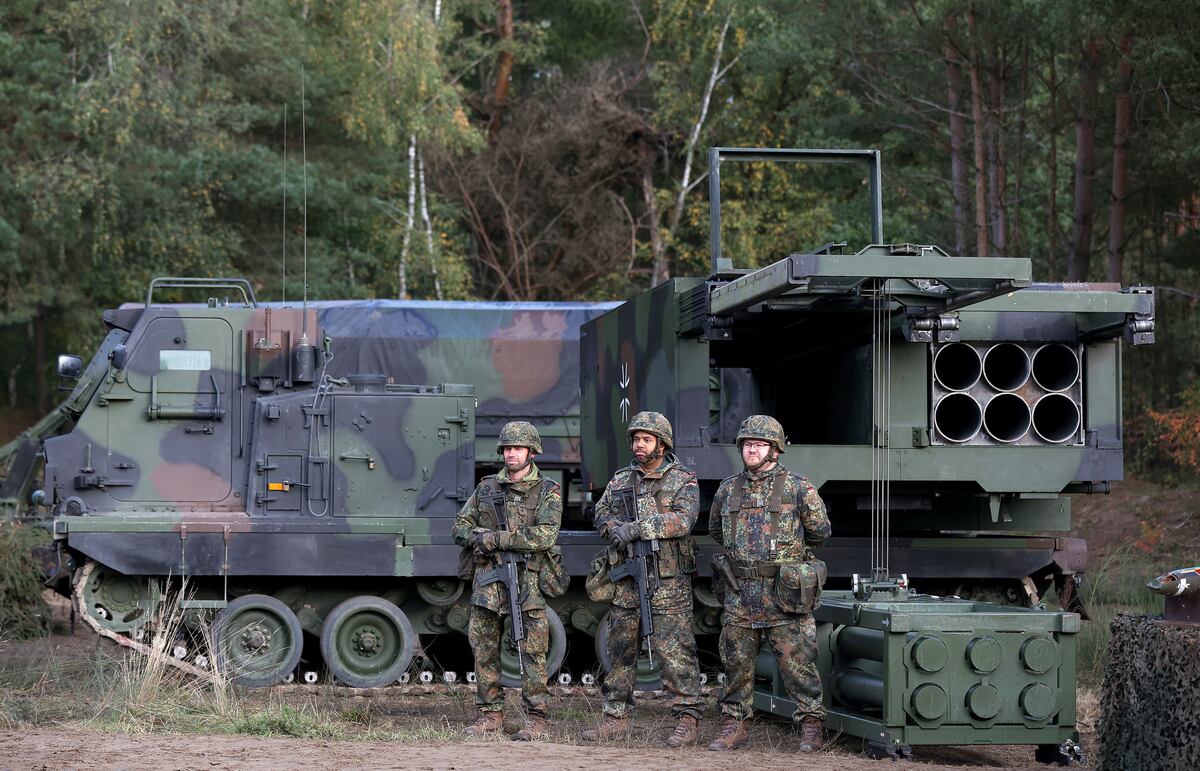
COLOGNE, Germany — Germany’s adoption of the Israeli-designed PULS rocket artillery weapon is set to emerge as a test case for European nations diversifying their arms suppliers away from American contractors that have dominated the market for decades.
Leaders in Berlin formalized the decision in favor of the Precise and Universal Launching System, or PULS, made by Elbit, last week, as the contractor announced a $57 million contract. German lawmakers had approved the funds late last year, with an initial five systems to be procured.
For Germany, a key PULS feature is that it can fire rockets of various calibers, ranging from 122mm to 370mm, produced by different manufacturers. On its website, Elbit claims the system “can fire a variety of ammunition types to various ranges from the same position, to ranges of up to 300 [kilometers].”
Germany’s preference for the weapon as a candidate for replacing its existing multiple-rocket launch system, or MLRS, arsenal, sold by Lockheed Martin and named MARS II here, has irked the U.S. defense giant, who fears losing out market share for rockets, in particular.
Experts said the market dynamics in artillery resemble those of desktop printers and ink cartridges in the world of office supplies: Once a government opts for launcher, its armed forces are locked into the vendors lineup of missiles.
In particular, the standard, single-warhead, guided munition for the Lockheed lineup, known as GMLRS Unitary, can typically be fired only from the company’s launchers, which are mounted on tracked or wheeled vehicles.
The wheeled variant, known as HIMARS , has famously proven successful in beating back invading Russian forces in Ukraine. Kyiv’s Western backers have donated launchers and GMLRS missiles in considerable numbers since the war began almost three years ago.
There is an exception in the way Germany and a small group of European countries have been able to use their Lockheed MRLS launchers, and specifically, what kinds of missiles the system’s fire control system will accept. In the context of the European Fire Control System, Berlin has long had U.S. government approval to fire non-U.S. munitions, namely a type of rocket for scattering AT2 antitank mines, which Germany has also donated to Ukraine.
Last year, as Germany had signaled an interest in PULS, Washington updated the scope of the agreement for using interface documents specific to the U.S. M-270 fire control system, Defense News has learned. The change, sources said, effectively meant Berlin would not have permission to launch Lockheed’s missiles out of PULS.
German defense officials declined to comment on the change or describe it in detail, referring only to a “political” holdup — versus a technical incompatibility — that would now rest with the Trump administration for resolution.
A Ministry of Defense spokesman told Defense News that Elbit had “confirmed the technical feasibility of firing the GMLRS Unitary rockets.”
Lockheed turned up the heat last summer in marketing its competing offer for Germany’s rocket artillery upgrade, which the company calls GMARS .
If Germany wanted to use its stock of GMLRS rockets, no product other than GMARS would do, executives said. In essence, the entire family of Lockheed missiles would be off the table for the Bundeswehr, Germany’s armed forces, they argued.
It’s unclear how many GMLRS missiles Germany has in its inventory. In 2020, the Bundeswehr ordered 1,818 new unitary missiles of this type for a total of €278 million ($289 million). Germany has since donated a number of the rockets to Ukraine, though the Ministry of Defence has not included figures in its running list of military aid.
Meanwhile, there appears to be little urgency in Berlin to resolve the PULS-Lockheed incompatibility.
For one, the Bundeswehr still has between 35 and 40 MARS launchers for firing whatever GMLRS inventory is left. In addition, there is an expectation that future orders for the missile would lead the U.S. government to soften its restrictive stance on mandatory launchers.
“Demand can create interoperability,” quipped one defense official.
There is also the calculus of leaning on German and European companies to build missiles in the variants and ranges that Lockheed is offering. Such a move would also eliminate unpredictability that comes with the U.S. Army, as Lockheed’s primary customer, dictating the missile production cadence for international customers, the thinking in Berlin goes.
Sebastian Sprenger is associate editor for Europe at Defense News, reporting on the state of the defense market in the region, and on U.S.-Europe cooperation and multi-national investments in defense and global security. Previously he served as managing editor for Defense News. He is based in Cologne, Germany.
Linus Höller is Defense News' Europe correspondent and OSINT investigator. He reports on the arms deals, sanctions, and geopolitics shaping Europe and the world. He holds master’s degrees in WMD nonproliferation, terrorism studies, and international relations, and works in four languages: English, German, Russian, and Spanish.
德国科隆——德国采用以色列设计的 PULS 火箭炮武器,将成为欧洲各国摆脱对美国承包商的依赖、实现武器供应商多元化的一个试验案例。几十年来,美国承包商一直主导着欧洲武器市场。
上周,柏林领导人正式批准了埃尔比特公司(Elbit)的精确通用发射系统(PULS)项目,该公司宣布了一份价值5700万美元的合同。德国议员于去年年底批准了这笔资金,首批将采购五套系统。
对德国而言,PULS系统的一项关键特性是它可以发射不同口径的火箭弹,口径范围从122毫米到370毫米不等,且这些火箭弹由不同的制造商生产。埃尔比特系统公司在其网站上声称,该系统“可以从同一位置向不同射程发射多种类型的弹药,射程最远可达300公里”。
德国倾向于选择这种武器来取代其现有的由洛克希德·马丁公司出售、在美国被称为 MARS II 的多管火箭发射系统(MLRS),这激怒了这家美国国防巨头,他们担心会失去火箭的市场份额。
专家表示,火炮市场动态与办公用品领域的桌面打印机和墨盒类似:一旦一个政府选择了发射器,其武装部队就只能使用供应商提供的导弹产品线。
具体来说,洛克希德公司的标准单弹头制导武器,即 GMLRS Unitary,通常只能从该公司的发射器发射,这些发射器安装在履带式或轮式车辆上。
轮式版本,即HIMARS,在击退入侵乌克兰的俄罗斯军队方面取得了显著成效。自近三年前战争爆发以来,基辅的西方支持者已向乌克兰捐赠了大量的发射器和GMLRS导弹。
德国和少数欧洲国家在使用洛克希德多管火箭炮系统(MRLS)的方式上存在例外,尤其是在该系统火控系统可接受的导弹类型方面。就欧洲火控系统而言,柏林长期以来一直获得美国政府的批准,可以发射非美国制造的弹药,例如一种用于散布AT2反坦克地雷的火箭弹,德国也曾向乌克兰捐赠过这种火箭弹。
据《防务新闻》报道,去年,由于德国对PULS系统表现出兴趣,华盛顿方面更新了协议范围,允许使用专门针对美国M-270火控系统的接口文件。消息人士称,这一变化实际上意味着柏林将无权使用PULS系统发射洛克希德·马丁公司的导弹。
德国国防部官员拒绝就这一变化发表评论或详细描述,仅表示这是“政治”阻碍,而非技术不兼容,现在将由特朗普政府来解决。
英国国防部发言人告诉《防务新闻》,埃尔比特公司“已确认发射 GMLRS 单体火箭的技术可行性”。
去年夏天,洛克希德公司加大了对德国火箭炮升级项目的竞争性推销力度,该公司称之为 GMARS。
高管们表示,如果德国想要使用其库存的GMLRS火箭,除了GMARS之外,其他任何产品都不行。他们认为,实际上,洛克希德公司生产的整个导弹系列都将无法被德国联邦国防军(德国武装部队)选用。
目前尚不清楚德国库存中有多少枚GMLRS导弹。2020年,德国联邦国防军订购了1818枚新型单体导弹,总价值2.78亿欧元(约合2.89亿美元)。此后,德国向乌克兰捐赠了部分此类导弹,但德国国防部并未在其军事援助清单中列出具体数字。
与此同时,柏林方面似乎并不急于解决 PULS 与洛克希德系统不兼容的问题。
首先,德国联邦国防军目前仍拥有35至40套MARS导弹发射系统,用于发射剩余的GMLRS导弹。此外,人们预期未来对该导弹的订单将促使美国政府放宽其对强制配备发射系统的严格立场。
一位国防官员打趣道:“需求可以创造互操作性。”
此外,还有一种策略是依靠德国和欧洲公司生产洛克希德公司提供的各种型号和射程的导弹。柏林方面认为,此举还能消除美国陆军(洛克希德公司的主要客户)主导国际客户导弹生产节奏所带来的不确定性。
塞巴斯蒂安·斯普伦格是《防务新闻》欧洲版副主编,负责报道该地区的防务市场状况,以及美欧在防务和全球安全领域的合作和多国投资。此前,他曾担任《防务新闻》执行主编。他现居德国科隆。
林努斯·霍勒是《防务新闻》的欧洲记者和开源情报调查员。他报道影响欧洲乃至全球的军火交易、制裁和地缘政治。他拥有大规模杀伤性武器不扩散、恐怖主义研究和国际关系三个硕士学位,并精通英语、德语、俄语和西班牙语四种语言。