Remains of Cuban officers killed during Venezuela strike repatriated委内瑞拉空袭中阵亡的古巴军官遗骸被运回古巴
The bodies of 32 Cuban officers killed during a stunning U.S. attack on Venezuela have been repatriated to their homeland.
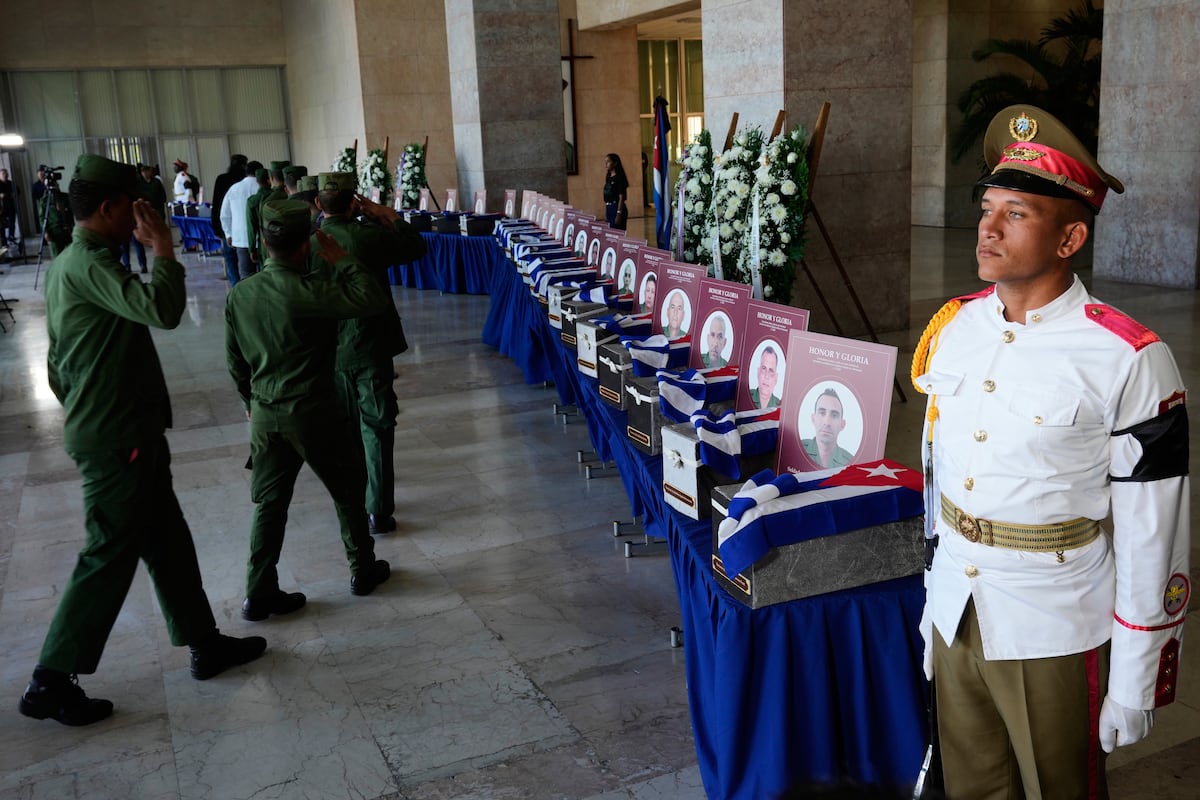
HAVANA — Cuban soldiers wearing white gloves marched out of a plane on Thursday carrying urns with the remains of the 32 Cuban officers killed during a stunning U.S. attack on Venezuela as trumpets and drums played solemnly at Havana’s airport.
Nearby, thousands of Cubans lined one of Havana’s most iconic streets to await the bodies of colonels, lieutenants, majors and captains as the island remained under threat by the administration of U.S. President Donald Trump .
The soldiers’ shoes clacked as they marched stiff-legged into the headquarters of the Ministry of the Armed Forces, next to Revolution Square, with the urns and placed them on a long table next to the pictures of those killed. Tens of thousands of people paid their respects, saluting the urns or holding their hand over their heart, many of them drenched from standing outside in a heavy downpour.
Thursday’s mass funeral was only one of a handful that the Cuban government has organized in almost half a century.
Hours earlier, state television showed images of more than a dozen wounded people described as “combatants” accompanied by Cuban Foreign Minister Bruno Rodríguez arriving Wednesday night from Venezuela. Some were in wheelchairs.
Those injured and the remains of those killed arrived as tensions grow between Cuba and the U.S., with Trump recently demanding that the Caribbean country make a deal with him before it is “too late.” He did not explain what kind of deal.
Trump also has said that Cuba will no longer live off Venezuela’s money and oil. Experts warn that the abrupt end of oil shipments could be catastrophic for Cuba, which is already struggling with serious blackouts and a crumbling power grid.
‘That will always unite us’
Officials unfurled a massive flag at Havana’s airport as President Miguel Díaz-Canel, clad in military garb as commander of Cuba’s Armed Forces, stood silent next to former President Raúl Castro, with what appeared to be the relatives of those killed looking on nearby.
Cuban Interior Minister Lázaro Alberto Álvarez Casa said Venezuela was not a distant land for those killed, but a “natural extension of their homeland.”
“The enemy speaks to an audience of high-precision operations, of troops, of elites, of supremacy,” Álvarez said in apparent reference to the U.S. “We, on the other hand, speak of faces, of families who have lost a father, a son, a husband, a brother.”
Álvarez called those slain “heroes,” saying that they were an example of honor and “a lesson for those who waver.”
“We reaffirm that if this painful chapter of history has demonstrated anything, it is that imperialism may possess more sophisticated weapons; it may have immense material wealth; it may buy the minds of the wavering; but there is one thing it will never be able to buy: the dignity of the Cuban people,” he said.
Thousands of Cubans lined a street where motorcycles and military vehicles thundered by with the remains of those killed.
“They are people willing to defend their principles and values, and we must pay tribute to them,” said Carmen Gómez, a 58-year-old industrial designer, adding that she hopes no one invades given the ongoing threats.
When asked why she showed up despite the difficulties Cubans face, Gómez replied, “It’s because of the sense of patriotism that Cubans have, and that will always unite us.”
‘People are upset and hurt’
Cuba recently released the names and ranks of 32 military personnel — ranging in age from 26 to 60 — who were part of the security detail of Venezuelan President Nicolás Maduro during the raid on his residence on Jan. 3. They included members of the Revolutionary Armed Forces and the Ministry of the Interior, the island’s two security agencies.
Cuban and Venezuelan authorities have said that the uniformed personnel were part of protection agreements between the two countries.
A demonstration was planned for Friday across from the U.S. Embassy in an open-air forum known as the Anti-Imperialist Tribune. Officials have said they expect the demonstration to be massive.
“People are upset and hurt. There’s a lot of talk on social media; but many do believe that the dead are martyrs” of a historic struggle against the United States, analyst and former diplomat Carlos Alzugaray told The Associated Press.
The first mass funeral in decades
In October 1976, then-President Fidel Castro led a massive demonstration to bid farewell to the 73 people killed in the bombing of a Cubana de Aviación civilian flight financed by anti-revolutionary leaders in the U.S. Most of the victims were Cuban athletes.
In December 1989, officials organized “Operation Tribute” to honor the more than 2,000 Cuban combatants who died in Angola during Cuba’s participation in the war that defeated the South African army and ended the apartheid system. In October 1997, memorial services were held following the arrival of the remains of guerrilla commander Ernesto “Che” Guevara and six of his comrades, who died in 1967.
The latest mass burial is critical to honor those slain, said José Luis Piñeiro, a 60-year-old doctor who lived four years in Venezuela.
“I don’t think Trump is crazy enough to come and enter a country like this, ours, and if he does, he’s going to have to take an aspirin or some painkiller to avoid the headache he’s going to get,” Piñeiro said. “These were 32 heroes who fought him. Can you imagine an entire nation? He’s going to lose.”
Cuba riled by US aid for hurricane recovery
A day before the remains of those killed arrived in Cuba, the U.S. announced $3 million in additional aid to help the island recover from the catastrophic Hurricane Melissa .
The first flight took off on Wednesday, and a second flight was scheduled for Friday. A commercial vessel also will deliver food and other supplies.
Jeremy Lewin, the State Department official in charge of foreign assistance, said the U.S. was working with Cuba’s Catholic Church to distribute aid.
“There’s nothing political about cans of tuna and rice and beans and pasta,” he said Thursday, warning that the Cuban government should not intervene or divert supplies. “We will be watching, and we will hold them accountable.”
Lewin said he saw no contradiction between cutting off Venezuelan oil and offering aid, saying that “the Cuban regime was taking illegitimate profits from the narco-terrorists.”
He said the U.S. hopes that delivering aid via the Catholic Church will be part of a new and broader push to deliver assistance directly to the Cuban people.
“Ultimately, the regime has to make a choice,” Lewin said. “Step down or better provide towards people.”
Lewin added that “if there was no regime,” the U.S. would provide “billions and billions of dollars” in assistance, as well as investment and development: “That’s what lies on the other side of the regime for the Cuban people.”
The announcement riled Cuban Foreign Minister Bruno Rodríguez.
“The U.S. government is exploiting what appears to be a humanitarian gesture for opportunistic and politically manipulative purposes,” he said in a statement. “As a matter of principle, Cuba does not oppose assistance from governments or organizations, provided it benefits the people and the needs of those affected are not used for political gain under the guise of humanitarian aid.”
Coto contributed from San Juan, Puerto Rico.
哈瓦那——周四,在哈瓦那机场,号角和鼓声庄严地响起,一群戴着白手套的古巴士兵从飞机上走下来,他们手捧骨灰瓮,里面装着在美军对委内瑞拉发动的惊人袭击中丧生的32名古巴军官的遗骸。
在附近,成千上万的古巴人聚集在哈瓦那最具标志性的街道之一,等待着上校、中尉、少校和上尉的遗体被运走,因为该岛仍然受到美国总统唐纳德·特朗普政府的威胁。
士兵们迈着笔直的步伐,皮鞋发出清脆的响声,他们抬着骨灰瓮,步履蹒跚地走进革命广场旁的武装部队总部,并将骨灰瓮放在长桌上,旁边摆放着阵亡者的照片。成千上万的民众前来致敬,向骨灰瓮敬礼或将手放在胸前,许多人因在外面暴雨中站立而浑身湿透。
周四举行的集体葬礼是古巴政府近半个世纪以来组织的寥寥几场葬礼之一。
数小时前,古巴国家电视台播放了十几名被描述为“战斗人员”的伤员的画面,他们于周三晚间在古巴外交部长布鲁诺·罗德里格斯的陪同下从委内瑞拉抵达古巴。其中一些人坐在轮椅上。
随着古巴和美国之间的紧张局势加剧,伤者和遇难者遗体被运抵古巴。特朗普最近要求这个加勒比海国家在“为时已晚”之前与他达成协议,但他没有解释是什么样的协议。
特朗普还表示,古巴将不再依赖委内瑞拉的资金和石油。专家警告说,石油供应的突然中断可能对古巴造成灾难性后果,古巴目前已经饱受严重停电和电网崩溃的困扰。
“这将永远把我们团结在一起。”
在哈瓦那机场,官员们展开了一面巨大的国旗。古巴总统米格尔·迪亚斯-卡内尔身着军装,担任古巴武装部队总司令,他默默地站在前总统劳尔·卡斯特罗旁边,附近似乎还有一些遇难者的亲属在旁观看。
古巴内政部长拉萨罗·阿尔贝托·阿尔瓦雷斯·卡萨表示,委内瑞拉对那些遇难者来说不是遥远的地方,而是“他们祖国的自然延伸”。
“敌人谈论的是高精度作战、军队、精英和绝对优势,”阿尔瓦雷斯显然指的是美国,“而我们谈论的是一张张面孔,是那些失去了父亲、儿子、丈夫、兄弟的家庭。”
阿尔瓦雷斯称那些遇难者为“英雄”,说他们是荣誉的典范,“给那些动摇的人上了一课”。
“我们重申,如果说这段痛苦的历史篇章证明了什么,那就是帝国主义或许拥有更先进的武器;或许拥有巨额的物质财富;或许能够收买那些摇摆不定的人;但有一件事它永远买不到:那就是古巴人民的尊严,”他说。
成千上万的古巴人聚集在街道两旁,摩托车和军车轰隆隆地驶过,车上载着遇难者的遗体。
“他们是愿意捍卫自己原则和价值观的人,我们必须向他们致敬,”58 岁的工业设计师卡门·戈麦斯说道,并补充说,鉴于持续不断的威胁,她希望没有人入侵。
当被问及为何不顾古巴人民面临的种种困难而出席活动时,戈麦斯回答说:“这是因为古巴人民拥有爱国主义精神,这种精神将永远把我们团结在一起。”
“人们感到沮丧和受伤”
古巴最近公布了 32 名军人的姓名和军衔,年龄从 26 岁到 60 岁不等,他们是 1 月 3 日突袭委内瑞拉总统尼古拉斯·马杜罗住所时负责其安保工作的人员。这些人包括古巴革命武装力量和内政部的成员,这两个机构是古巴的两个安全机构。
古巴和委内瑞拉当局表示,这些身穿制服的人员是两国之间保护协议的一部分。
原计划周五在美国大使馆对面的露天广场“反帝国主义论坛”举行示威活动。官员表示,预计示威规模将非常庞大。
“人们感到愤怒和伤心。社交媒体上有很多议论;但许多人确实相信,死者是这场对抗美国的历史性斗争中的烈士,”分析人士、前外交官卡洛斯·阿尔祖加雷告诉美联社。
这是几十年来首次集体葬礼。
1976 年 10 月,时任总统菲德尔·卡斯特罗领导了一场大规模示威游行,悼念在古巴航空公司一架民用航班爆炸案中丧生的 73 人。这起爆炸案是由美国反革命领导人资助的。大多数遇难者是古巴运动员。
1989年12月,古巴官员组织了“致敬行动”,以纪念在古巴参与的安哥拉战争中牺牲的2000多名古巴战士。这场战争最终击败了南非军队,结束了种族隔离制度。1997年10月,在游击队指挥官埃内斯托·“切”·格瓦拉及其六位战友的遗骸抵达后,举行了纪念仪式。他们于1967年牺牲。
曾在委内瑞拉生活四年的 60 岁医生何塞·路易斯·皮涅罗表示,最近这次集体葬礼对于缅怀遇难者至关重要。
“我不认为特朗普会疯狂到入侵我们这样的国家,如果他真来了,他肯定得吃点阿司匹林或者止痛药才能避免头疼,”皮涅罗说。“这可是32位英雄与他战斗啊。你能想象一个国家会是什么样子吗?他肯定会输。”
美国向古巴提供飓风灾后重建援助,引发古巴不满。
在遇难者遗体抵达古巴的前一天,美国宣布追加 300 万美元援助,帮助该岛从灾难性的飓风梅丽莎中恢复过来。
首架航班于周三起飞,第二架航班计划于周五起飞。此外,一艘商船也将运送食品和其他物资。
美国国务院负责对外援助的官员杰里米·莱文表示,美国正在与古巴天主教会合作分发援助物资。
“罐头金枪鱼、大米、豆子和意大利面与政治无关,”他周四表示,并警告古巴政府不应干预或转移物资供应。“我们将密切关注,并追究他们的责任。”
莱文表示,他认为切断委内瑞拉石油供应和提供援助之间没有矛盾,并称“古巴政权正在从毒品恐怖分子那里获取非法利润”。
他说,美国希望通过天主教会提供援助,能够成为一项新的、更广泛的行动的一部分,直接向古巴人民提供援助。
“归根结底,政权必须做出选择,”莱文说。“要么下台,要么更好地为人民服务。”
莱文补充说,“如果没有这个政权”,美国将提供“数十亿美元”的援助,以及投资和发展:“这就是古巴人民在政权另一边所能得到的。”
这一声明激怒了古巴外交部长布鲁诺·罗德里格斯。
他在一份声明中说:“美国政府正在利用看似人道主义的举动,达到其投机取巧和政治操纵的目的。原则上,古巴不反对各国政府或组织的援助,只要这些援助造福于古巴人民,并且不会以人道主义援助为幌子,利用受援者的需求谋取政治利益。”
科托来自波多黎各圣胡安。