Trump encourages Latin American leaders to use military action to help US fight cartels特朗普鼓励拉美领导人采取军事行动,帮助美国打击贩毒集团
The gathering came just two months after Trump ordered an audacious U.S. military operation to capture Venezuela’s then-president, Nicolás Maduro.
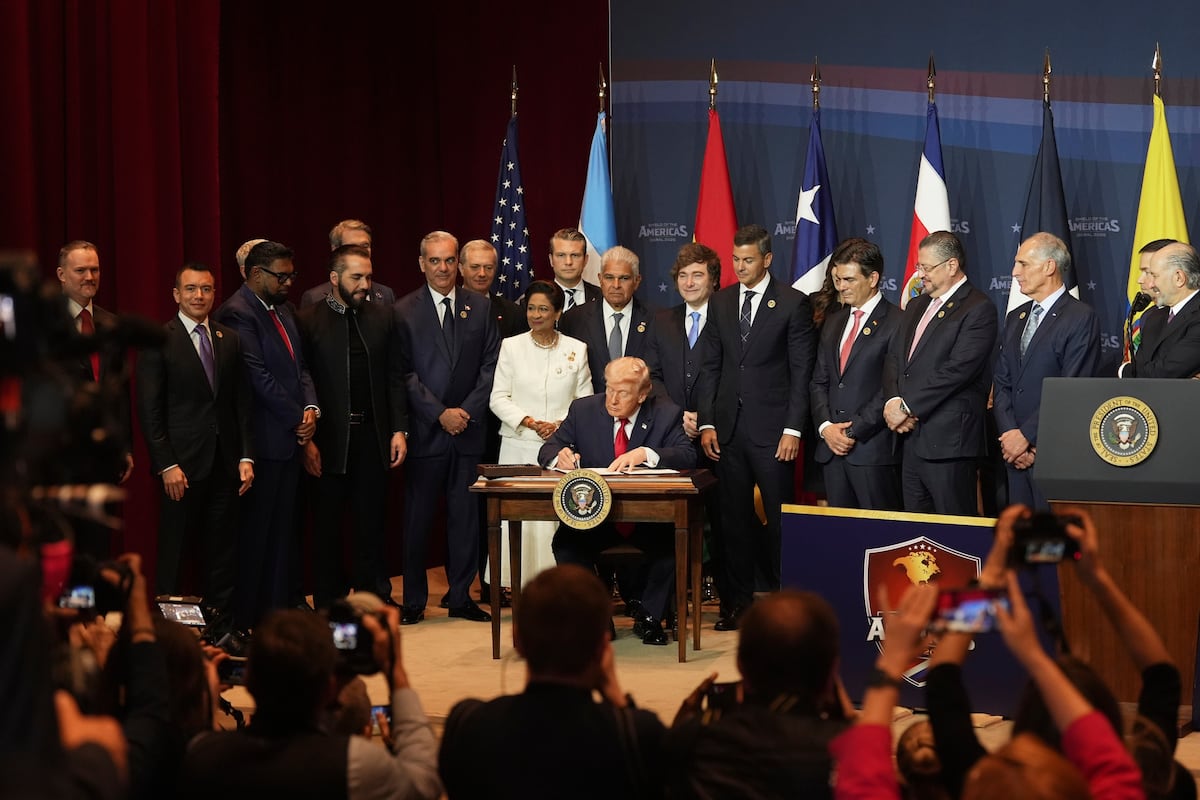
DORAL, Fla. — President Donald Trump said Saturday that the United States and Latin American countries are banding together to combat violent cartels as his administration looks to demonstrate it remains committed to sharpening U.S. foreign policy focus on the Western Hemisphere even while dealing with five-alarm crises around the globe.
Trump encouraged regional leaders gathered at his Miami-area golf club to take military action against drug trafficking cartels and transnational gangs that he says pose an “unacceptable threat” to the hemisphere’s national security.
“The only way to defeat these enemies is by unleashing the power of our militaries,” Trump said. “We have to use our military. You have to use your military.” Citing the U.S.-led coalition that confronted the Islamic State group in the Middle East, the Republican president said that “we must now do the same thing to eradicate the cartels at home.”
The gathering, which the White House called the “Shield of the Americas” summit, came just two months after Trump ordered an audacious U.S. military operation to capture Venezuela’s then-president, Nicolás Maduro, and whisk him and his wife to the United States to face drug conspiracy charges.
Looming even larger is Trump’s decision to launch a war on Iran with Israel one week ago, a conflict that has left hundreds dead, convulsed global markets and unsettled the broader Middle East .
Trump’s time with the Latin American leaders was limited: Afterward, he set out for Dover Air Force Base, Delaware, to be on hand for the dignified transfer of the six U.S. troops killed in a drone strike on a command center in Kuwait, one day after the U.S. and Israel launched their military campaign against Iran.
Trump called the American deaths a “very sad situation” and praised the fallen troops as “great heroes.”
With the summit, Trump aimed to turn attention to the Western Hemisphere, at least for a moment. He has pledged to reassert U.S. dominance in the region and push back on what he sees as years of Chinese economic encroachment in America’s backyard.
Trump also said the U.S. will turn its attention to Cuba after the war with Iran and suggested his administration would cut a deal with Havana, underscoring Washington’s increasingly aggressive stance against the island’s communist leadership. “Great change will soon be coming to Cuba,” he said, adding that “they’re very much at the end of the line.”
Cuban officials have said on several occasions that they were open to dialogue with the U.S. as long as it was based on respect for Cuban sovereignty, but they have never confirmed that such talks were taking place.
The leaders of Argentina, Bolivia, Chile, Costa Rica, the Dominican Republic, Ecuador, El Salvador, Guyana, Honduras, Panama, Paraguay, and Trinidad and Tobago joined the Republican president at Trump National Doral Miami, a golf resort where he is also set to host the Group of 20 summit later this year.
The idea for a summit of like-minded conservatives from across the hemisphere emerged from the ashes of what was to be the 10th edition of the Summit of the Americas, which was scrapped during the U.S. military buildup off the coast of Venezuela last year.
Host Dominican Republic, pressured by the White House, had barred Cuba, Nicaragua and Venezuela from attending the regional gathering. But after leftist leaders in Colombia and Mexico threatened to pull out in protest — and with no commitment from Trump to attend — the Dominican Republic’s president, Luis Abinader, decided at the last minute to postpone the event, citing “deep differences” in the region.
The Shield of the Americas moniker was meant to speak to Trump’s vision for an “America First” foreign policy toward the region that leverages U.S. military and intelligence assets unseen across the area since the end of the Cold War.
To that end, Ecuador and the United States conducted military operations this week against organized crime groups in the South American country. Ecuadorian and U.S. security forces attacked a refuge belonging to the Colombian illegal armed group Comandos de la Frontera in the Ecuadorian Amazon on Friday, authorities reported.
This joint fight against drug traffickers “is only the beginning,” said Ecuador’s president, Daniel Noboa.
Notably missing at the summit were the region’s two dominant powers — Brazil and Mexico — as well as Colombia, long the linchpin of U.S. anti-narcotics strategy in the region.
Trump grumbled that Mexico is the “epicenter of cartel violence” with drug kingpins “orchestrating much of the bloodshed and chaos in this hemisphere.”
“The cartels are running Mexico,” Trump said. “We can’t have that. Too close to us. Too close to you.”
The challenge from China
Trump made no mention of his administration’s insistence that countering Chinese influence in the hemisphere is a top priority for his second term.
His national security strategy promotes the “Trump Corollary” to the 19th century Monroe Doctrine, which had sought to ban European incursions in the Americas, by targeting Chinese infrastructure projects, military cooperation and investment in the region’s resource industries.
The first demonstration of the more muscular approach was Trump’s strong-arming of Panama to withdraw from China’s Belt and Road Initiative and review long-term port contracts held by a Hong Kong-based company amid U.S. threats to retake the Panama Canal.
More recently, the U.S. capture of Maduro and Trump’s pledge to “run” Venezuela threatens to disrupt oil shipments to China — the biggest buyer of Venezuelan crude before the raid — and bring into Washington’s orbit one of Beijing’s closest allies in the region. Trump is scheduled to travel to Beijing later this month to meet with Chinese President Xi Jinping.
For many countries, China’s trade-focused diplomacy fills a critical financial void in a region with major development challenges ranging from poverty reduction to infrastructure bottlenecks. In contrast, Trump has been slashing foreign assistance to the region while rewarding countries lined up behind his crackdown on immigration — a policy widely unpopular across the hemisphere.
Secretary of State Marco Rubio hosted the leaders for a working lunch after Trump left for the event in Delaware. The lunch gave Kristi Noem, whom Trump fired as homeland security secretary on Thursday, the chance to make her debut in her new role as a special envoy for the “Shield of the Americas.”
“We want our hemisphere to be safer, to be more sovereign, and to be more prosperous,” Noem told the leaders.
Durkin Richer reported from Washington. Associated Press writer Gabriela Molina in Quito, Ecuador, contributed to this report.
佛罗里达州多拉尔——唐纳德·特朗普总统周六表示,美国和拉丁美洲国家正在联合起来打击暴力贩毒集团,他的政府希望借此表明,即使在应对全球五级危机的同时,美国仍致力于加强对西半球的外交政策关注。
特朗普鼓励聚集在他位于迈阿密地区的高尔夫俱乐部的地区领导人对贩毒集团和跨国犯罪团伙采取军事行动,他称这些团伙和犯罪团伙对西半球的国家安全构成了“不可接受的威胁”。
特朗普说:“击败这些敌人的唯一方法就是动用我们军队的力量。我们必须动用军队,你们也必须动用军队。”这位共和党总统援引美国领导的打击中东伊斯兰国组织的联盟表示,“我们现在也必须采取同样的做法,铲除国内的贩毒集团。”
白宫称之为“美洲之盾”峰会的这次聚会,距离特朗普下令对委内瑞拉时任总统尼古拉斯·马杜罗进行大胆的美军军事行动,并将他和他的妻子带到美国面临毒品阴谋指控仅仅两个月。
更令人担忧的是,一周前特朗普决定与以色列联手对伊朗发动战争,这场冲突已造成数百人死亡,震动了全球市场,并扰乱了整个中东地区的局势。
特朗普与拉丁美洲领导人的会面时间有限:之后,他前往特拉华州多佛空军基地,参加在科威特指挥中心遭无人机袭击身亡的六名美军士兵的遗体移交仪式。就在一天前,美国和以色列对伊朗发动了军事行动。
特朗普称美军士兵的死亡是“非常令人悲痛的情况”,并称赞阵亡士兵是“伟大的英雄”。
通过此次峰会,特朗普意在将注意力转移到西半球,至少暂时如此。他承诺将重申美国在该地区的主导地位,并反击他所认为的中国多年来对美国“后院”的经济侵蚀。
特朗普还表示,美国将在伊朗战争结束后将注意力转向古巴,并暗示其政府将与哈瓦那达成协议,这凸显了华盛顿对古巴共产党领导层日益强硬的立场。他说:“古巴即将迎来巨大变革”,并补充说,“他们已经走到了尽头。”
古巴官员曾多次表示,只要对话建立在尊重古巴主权的基础上,他们就愿意与美国对话,但他们从未证实过此类会谈正在进行。
阿根廷、玻利维亚、智利、哥斯达黎加、多米尼加共和国、厄瓜多尔、萨尔瓦多、圭亚那、洪都拉斯、巴拿马、巴拉圭以及特立尼达和多巴哥的领导人与这位共和党总统齐聚迈阿密特朗普国家多拉尔高尔夫度假村,他将于今年晚些时候在此举办二十国集团峰会。
美洲峰会第十届峰会因美国去年在委内瑞拉海岸附近增兵而被取消,而召开此次峰会的想法正是在美洲峰会的废墟中诞生的。
在白宫的压力下,东道主多米尼加共和国禁止古巴、尼加拉瓜和委内瑞拉参加此次区域会议。但哥伦比亚和墨西哥的左翼领导人威胁要退出以示抗议,而特朗普又没有承诺出席,因此多米尼加共和国总统路易斯·阿比纳德尔在最后一刻决定推迟此次会议,理由是该地区存在“严重分歧”。
“美洲之盾”这一称号旨在体现特朗普对该地区“美国优先”外交政策的愿景,该政策利用了自冷战结束以来在该地区前所未见的美国军事和情报资源。
为此,厄瓜多尔和美国本周在该国开展了打击有组织犯罪集团的军事行动。据当局报告,厄瓜多尔和美国安全部队于周五袭击了位于厄瓜多尔亚马逊地区的哥伦比亚非法武装组织“边境突击队”(Comandos de la Frontera)的一处避难所。
厄瓜多尔总统丹尼尔·诺博亚表示,这场打击贩毒分子的联合行动“仅仅是个开始”。
值得注意的是,该地区的两个主导大国——巴西和墨西哥——以及长期以来一直是美国在该地区禁毒战略支柱的哥伦比亚均未出席此次峰会。
特朗普抱怨说,墨西哥是“贩毒集团暴力的中心”,毒枭们“策划了西半球的大部分流血和混乱”。
特朗普说:“贩毒集团控制着墨西哥。我们不能容忍这种情况。他们离我们太近了,离你们也太近了。”
来自中国的挑战
特朗普只字未提他的政府一直坚持认为,遏制中国在西半球的影响力是他第二个任期的首要任务。
他的国家安全战略将“特朗普推论”推广到 19 世纪的门罗主义,该主义旨在禁止欧洲入侵美洲,而特朗普推论的目标是中国的基础设施项目、军事合作以及对该地区资源行业的投资。
特朗普采取更强硬手段的第一次表现是,他强迫巴拿马退出中国的“一带一路”倡议,并要求巴拿马重新审查一家香港公司持有的长期港口合同,同时美国威胁要重新控制巴拿马运河。
最近,美国逮捕马杜罗以及特朗普承诺“掌控”委内瑞拉,都可能扰乱对华石油运输——中国是委内瑞拉原油的最大买家——并将北京在该地区最亲密的盟友之一拉入华盛顿的势力范围。特朗普计划于本月晚些时候访问北京,与中国国家主席习近平会晤。
对许多国家而言,中国以贸易为导向的外交填补了该地区重要的财政缺口,而该地区面临着从减贫到基础设施瓶颈等诸多发展挑战。相比之下,特朗普一直在大幅削减对该地区的援助,同时却奖励那些支持他打击移民政策的国家——这项政策在整个西半球都广不受欢迎。
特朗普前往特拉华州参加活动后,国务卿马可·卢比奥为各国领导人举办了工作午餐。此次午餐让周四被特朗普解雇的国土安全部长克里斯蒂·诺姆有机会首次以“美洲之盾”特使的身份亮相。
“我们希望我们的半球更安全、更独立、更繁荣,”诺姆对各国领导人说。
杜尔金·里奇从华盛顿报道。美联社驻厄瓜多尔基多记者加布里埃拉·莫利纳对本报道亦有贡献。