These wargames explored drone attacks on US military bases这些兵棋推演模拟了无人机对美国军事基地的袭击。
Many of the details of these wargames are classified, but one key finding is that protecting domestic U.S. bases can’t be just the military’s job.
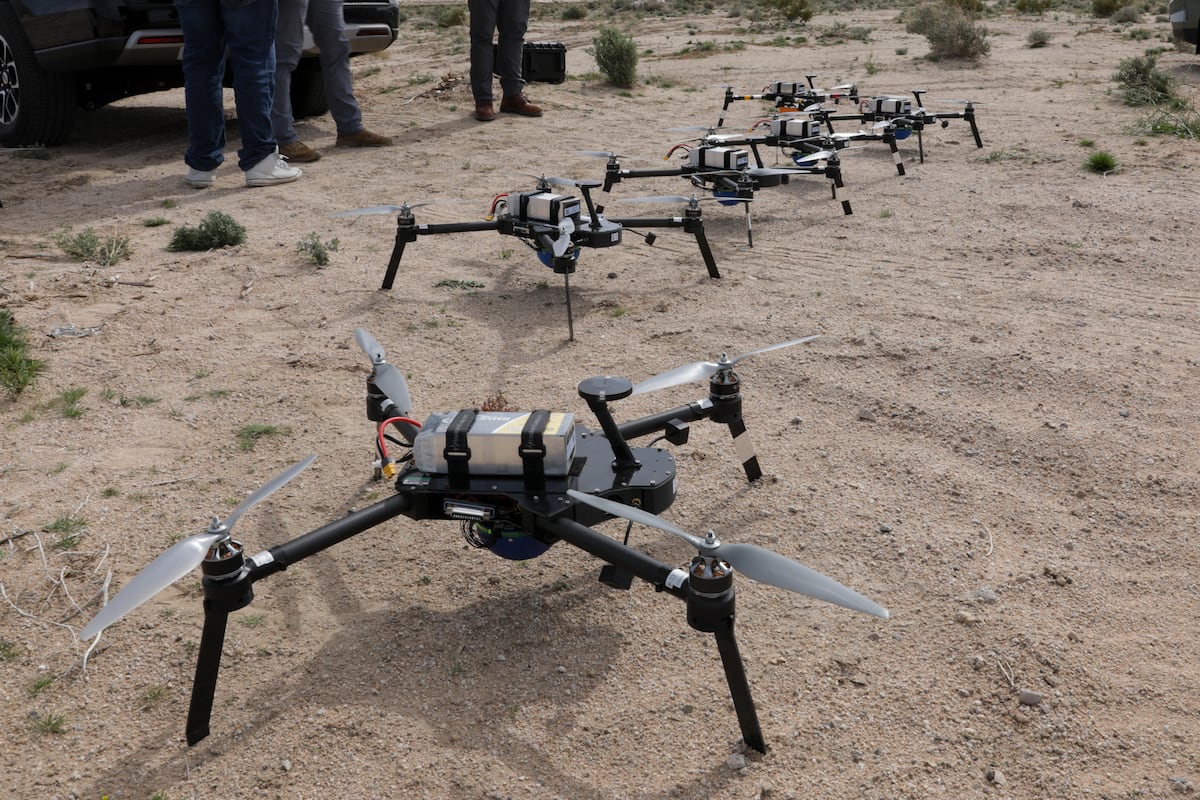
In March 2025, the U.S. government conducted a wargame on how to defend military bases in the United States from drone attacks.
Just three months later, what had seemed a theoretical possibility became frighteningly close to reality. In June 2025 came Ukraine’s Operation Spiderweb . Ukrainian agents had spent months smuggling hundreds of drones deep inside Russia. In a coordinated strike, more than 100 small drones destroyed 20 to 40 Russian warplanes on five airbases scattered from Moscow to Siberia.
The damage extended to more than Russian airpower or the Kremlin’s pride. The drone’s-eye videos of burning bombers sent a chilling signal to nations around the world. If this could happen to Russia, then it could happen to any country — including the United States.
Since 2022, the U.S. Army’s Joint Counter-Small Unmanned Aircraft Systems Office, or JCO, and the RAND Corp. think tank have held six wargames on how to mitigate the drone threat.
“We are trying to understand the policies and authorities we have in place to prevent us from contending with a scenario like Operation Spiderweb,” said Paul Lushenko, an assistant professor at the U.S. Army War College who helped run the drone wargame.
Many of the details of these wargames are classified, but one key finding is that protecting domestic U.S. bases can’t be just the military’s job.
“The tabletop exercise emphasized the need for a framework to integrate, enable, and synchronize state, local, tribal, and territorial authorities into counter-drone operations at or near military bases,” noted an essay by the game’s designers. But this, in turn, raises a slew of jurisdictional and communication issues.
This image, taken from video released June 1, 2025, by a source in the Ukrainian Security Service, shows a Ukrainian drone striking Russian planes deep in Russia's territory during Operation Spiderweb. (Ukrainian Security Service via AP)
By itself, Operation Spiderweb would have been an unpleasant reminder that the advent of small, easily transportable drones means that even installations thousands of miles from the battlefield aren’t safe. This is especially true for the U.S., which has been protected for centuries by two oceans and the absence of any significant adversary on its borders. Until recently, military bases had more to fear from terrorists or a crazed gunman crashing the gate, rather than a gaggle of small attack drones executing a miniature airstrike.
But, in fact, there have also been omens for years that drones were becoming a threat to U.S. installations. In 2016, the use of small weaponized drones by the Islamic State in Iraq made some American commanders uneasy. Then, in 2023, came a wave of mysterious drones that overflew Langley Air Force Base, causing no damage but generating much buzz about potentially hostile unmanned aerial vehicles in U.S. airspace. The U.S. government estimates that there were 350 drone incursions over military installations in 2024. While most came from careless or curious drone enthusiasts, the potential for hostile reconnaissance or attack is there.
Initially, the JCO/RAND wargames focused on the technical challenges of counter-drone defense. But the March 2025 exercise tackled a much more complex question: Who exactly has the responsibility — and the authority — for defending bases from drones?
“Let’s say you’ve got a drone flying down the Potomac,” said Christopher Pernin, a RAND researcher who helped run the drone wargames. “Maybe the FAA has signed off that the drone is approved to fly. Well, how can the people at the Pentagon know? They have to interrogate the system and look it up. Well, guess what? You’ve got 67 seconds to figure this out.”
In particular, the March wargame explored the conditions under which U.S. Northern Command — which is already responsible for securing North American airspace — would coordinate counter-drone defense of military bases. The exercise also explored how the joint military services and government agencies can maximize data sharing and situational awareness, as well as how to foster the use of counter-drone technologies such as jamming GPS signals.
Using Fort Bliss, Texas, and Joint Base Pearl Harbor, Hawaii, as the targets, the tabletop game included scenarios where the defender faced attacks by drones launched at various altitudes, bearings and distances. This served as a backdrop to stimulate discussions by over 100 participants from more than 30 federal and state agencies in what Lushenko described as “the largest interagency tabletop exercise in five years.”
The wargame identified three conditions under which NORTHCOM could support anti-drone defense of homeland bases.
“These include drone incursions that overwhelm the organic defensive capabilities of the services; are simultaneously conducted at different military bases, especially those performing essential missions; and, undermine public trust in the military and government,” the RAND essay said.
The exercise also endorsed the idea of NORTHCOM’s “flyaway kits,” which consist of mobile counter-drone systems and trained personnel that can be deployed via commercial aircraft as needed. However, these kits can do more than supplement what ideally would be a multilayered defense at military installations, including jamming, microwave and laser weapons and kinetic weapons such as machine guns.
Interestingly, the wargames suggested that the National Guard could play a crucial role in defending homeland military installations. Especially valuable would be the National Guard’s Civil Support Teams, which are available 24/7, can be deployed with 90 minutes and “have large budgets that can offset the equipping and training costs for counter-drone operations,” the RAND essay noted.
“There are some imaginative things we can do to further optimize our state-based military, through the National Guard, to respond to these drone incursions,” Lushenko added.
The defense of military bases is as much a matter of law as it is a matter of technology. For example, per Section 130i under Title 10 of the U.S. Code, the commanders of some bases are authorized to use force against drone intrusions, while others could face prosecution.
Compounding the problem is that with around 500 military installations around the U.S, there are a hodgepodge of different rules of engagement. At some sites, the instructions from commanders are “‘no drones on my installation, you have carte blanche to do whatever you need,’” said Pernin.
“They know exactly what they’re doing and they know what their goals are. I suspect there are a lot of places that don’t have that kind of goal setting. They see a UAV flying on the other side of the installation, and they think, ‘I’m not sure if I should take it out or just let it go.’”
Ultimately, the drone wargames were valuable simply by bringing together people from different agencies.
“We had a lot of crosstalk that I don’t think had happened before,” Pernin recalled. “We had a lot of occasions where people said, ‘I think this is so-and-so’s role.’ But that person was in the room, and they would say, ‘no, it’s not ours.’”
2025年3月,美国政府进行了一次战争演习,研究如何防御美国境内的军事基地免受无人机袭击。
仅仅三个月后,原本看似天方夜谭的事情就令人恐惧地逼近了现实。2025年6月,乌克兰发动了“蜘蛛网行动”。乌克兰特工花费数月时间,将数百架无人机走私到俄罗斯境内深处。在一次协同打击中,超过100架小型无人机摧毁了分布在莫斯科至西伯利亚五个空军基地的20至40架俄罗斯战机。
此次事件造成的损失远不止俄罗斯空军力量或克里姆林宫的颜面受损。无人机拍摄的轰炸机燃烧的画面向世界各国发出了令人不寒而栗的信号。如果这种事会发生在俄罗斯,那么任何国家——包括美国——都可能面临同样的命运。
自 2022 年以来,美国陆军联合反小型无人机系统办公室 (JCO) 和兰德公司智库已经举行了六次战争游戏,探讨如何减轻无人机威胁。
“我们正在努力了解我们现有的政策和权限,以防止我们面临类似‘蜘蛛网行动’的情况,”美国陆军战争学院助理教授保罗·卢申科说道,他曾参与组织无人机战争游戏。
这些战争演习的许多细节都是机密,但一个关键发现是,保护美国国内基地不能仅仅是军队的责任。
“桌面演练强调了建立一个框架的必要性,以便将州、地方、部落和领土当局整合起来,协调一致地参与到军事基地附近或基地内的反无人机行动中,”游戏设计者的一篇文章指出。但这反过来又引发了一系列管辖权和沟通问题。
这张图片截取自乌克兰安全局消息人士于2025年6月1日发布的视频,显示一架乌克兰无人机在“蜘蛛网行动”期间袭击了深入俄罗斯领空的俄罗斯飞机。(乌克兰安全局供图,美联社发布)
单就“蜘蛛网行动”本身而言,它就足以令人不快地提醒人们,小型、易于运输的无人机的出现意味着,即使是距离战场数千英里的军事设施也并非安全无虞。对于美国而言尤其如此,几个世纪以来,美国一直受到两大洋的保护,且其边境地区几乎没有任何强大的对手。直到最近,军事基地更担心的是恐怖分子或疯狂的枪手闯入,而不是一群小型攻击无人机执行小型空袭。
但事实上,多年来一直有迹象表明无人机正在对美国设施构成威胁。2016年,伊斯兰国在伊拉克使用小型武装无人机,令一些美国指挥官感到不安。随后,在2023年,一波神秘无人机飞越兰利空军基地,虽然没有造成任何损失,但却引发了人们对美国领空可能存在敌对无人机的广泛关注。美国政府估计,2024年美国军事设施上空发生了350起无人机入侵事件。虽然大多数事件源于粗心大意或出于好奇的无人机爱好者,但敌对侦察或攻击的可能性依然存在。
最初,JCO/RAND 联合兵棋推演的重点是反无人机防御的技术挑战。但 2025 年 3 月的演习则着手解决一个更为复杂的问题:究竟谁负责——以及谁有权——保卫基地免受无人机袭击?
“假设有一架无人机沿着波托马克河飞行,”兰德公司研究员克里斯托弗·佩宁说道,他曾参与组织无人机战争演习。“也许美国联邦航空管理局已经批准这架无人机飞行。那么,五角大楼的人怎么才能知道呢?他们必须查询系统并进行查找。猜猜看?他们只有67秒的时间来弄清楚这一点。”
3月份的兵棋推演重点探讨了美国北方司令部(该司令部已负责北美空域安全)在何种情况下将协调军事基地的反无人机防御。此次演习还探讨了联合军事部门和政府机构如何最大限度地共享数据和提升态势感知能力,以及如何促进反无人机技术(例如干扰GPS信号)的应用。
此次桌面演练以德克萨斯州布利斯堡和夏威夷珍珠港联合基地为目标,模拟了防御方面对来自不同高度、方位和距离的无人机攻击的场景。超过100名来自30多个联邦和州机构的参与者围绕这一场景展开讨论,卢申科称之为“五年来规模最大的跨部门桌面演练”。
该兵棋推演确定了北方司令部可以支持国土基地反无人机防御的三种条件。
兰德公司的文章指出:“这些包括无人机入侵,这种入侵使军队自身的防御能力不堪重负;同时在不同的军事基地进行,特别是那些执行重要任务的基地;并且破坏了公众对军队和政府的信任。”
此次演习也认可了北方司令部提出的“便携式装备包”理念,该装备包包含移动式反无人机系统和训练有素的人员,可根据需要通过商用飞机进行部署。然而,这些装备包的作用远不止于补充军事设施理想的多层防御体系,后者还包括干扰武器、微波武器、激光武器以及机枪等动能武器。
有趣的是,兵棋推演表明,国民警卫队可以在保卫国土军事设施方面发挥关键作用。兰德公司的文章指出,国民警卫队的民事支援小组尤其重要,这些小组全天候待命,可在90分钟内完成部署,并且“拥有充足的预算,可以抵消反无人机行动的装备和训练成本”。
卢申科补充说:“我们可以采取一些富有想象力的措施,通过国民警卫队进一步优化我们以国家为基础的军队,以应对这些无人机入侵。”
军事基地的防御既是法律问题,也是技术问题。例如,根据美国法典第10篇第130i条,某些基地的指挥官有权对无人机入侵使用武力,而其他基地的指挥官则可能面临起诉。
雪上加霜的是,美国各地大约有500个军事设施,交战规则五花八门。佩尔宁说,在一些基地,指挥官的指示是“‘我的基地内禁止使用无人机,你们可以随意行动’”。
“他们非常清楚自己在做什么,也知道自己的目标是什么。我怀疑很多地方都没有这种目标设定。他们看到无人机在设施另一侧飞行,就会想,‘我不知道该不该把它打下来,还是就让它飞走。’”
归根结底,无人机战争演习的价值就在于它将不同机构的人员聚集在一起。
“我们之间有很多以前从未发生过的交流,”佩尔宁回忆道。“很多时候,人们会说,‘我认为这是某某的角色。’但那个人当时就在房间里,他们会说,‘不,这不是我们的。’”