China’s Recent J-36 Heavy Stealth Tactical Jet Testing Offers New Insights Into Its Evolving Design中国近期对歼-36重型隐形战术喷气机的测试,为我们深入了解其不断演进的设计提供了新的视角。
Recent video footage shows continued refinement of the J-36 design, and there has also been talk of laser armament for the jet.
By Joseph Trevithick
Published Sep 23, 2026 5:36 PM EDT
Chinese internet captures via X
China’s Chengdu Aircraft Corporation continues to press ahead with the development of its ‘J-36’ next-generation tailless heavy tactical jet . Recent flight testing has offered interesting new views of the still-evolving stealthy design from the top and behind, prompting discussion about the aircraft’s features. There has also been talk recently about whether the jet might receive a laser directed-energy weapon at some point in the future.
The J-36 first broke cover , along with another next-generation tailless tactical jet design generally referred to as the J-XDS , back in December of 2024 . There are understood to be at least four, and possibly five, J-36 prototypes flying now. A number of significant changes between prototypes have already been observed over the past two years, as you can read more about here .
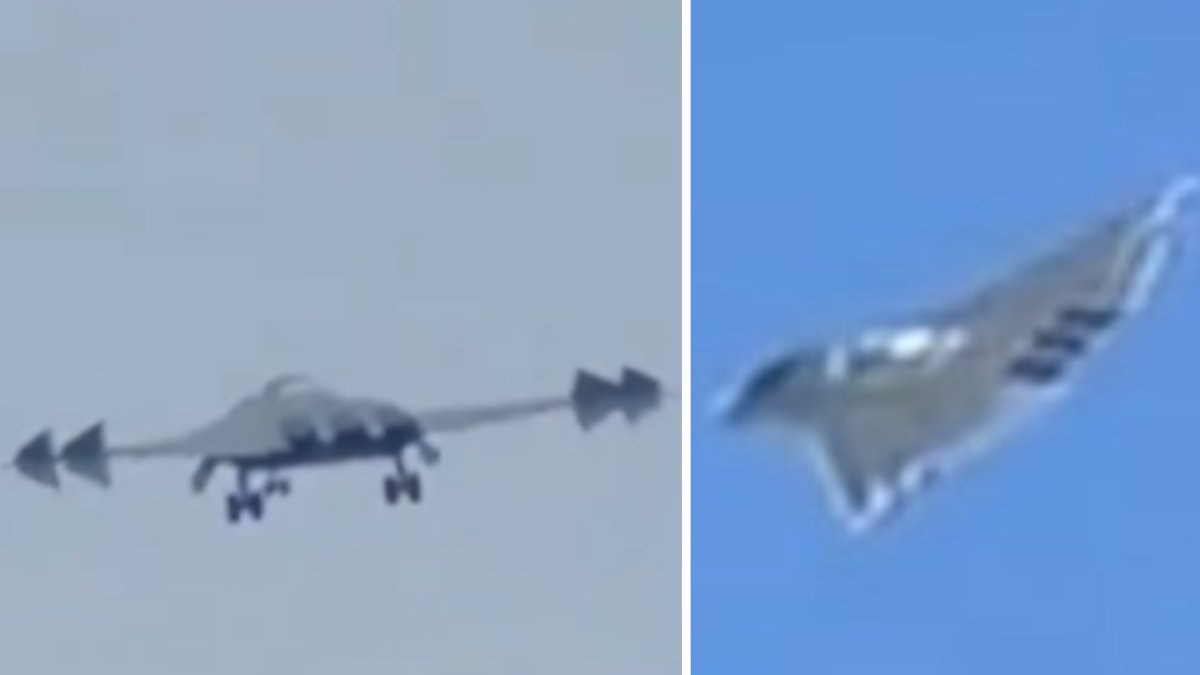
The most recent video of a J-36 test flight, seen in the social media post below, began circulating online yesterday. The footage shows the aircraft coming in to land, providing good general views of the uniquely three-engined jet with its two-seat, side-by-side cockpit configuration, especially from the rear aspect. What is seen underscores a previously observed total revision of the exhausts from a trough style to a two-dimensional thrust-vectoring configuration akin to what is found on the U.S. F-22 Raptor. This and other significant changes to the design, including the addition of divertless supersonic intakes (DSIs) all around, not just on top, first emerged last year . The clip also offers a good reminder of just how wide the aircraft is overall.
Obviously one of the best video recordings of the J-36 so far seen during landing approach … But can anyone read the number under the cockpit? 😉 https://t.co/cmQ0AkdsdO — @Rupprecht_A (@RupprechtDeino) September 22, 2026
Obviously one of the best video recordings of the J-36 so far seen during landing approach … But can anyone read the number under the cockpit? 😉 https://t.co/cmQ0AkdsdO
As this particular J-36 passes by, it can be seen to have a lighter-colored radome, as well as at least one relatively large lighter-colored section on top of the dorsal air intake. A similarly colored radome was first spotted on what is said to be the fourth prototype back in July. This coloring could point to the installation of actual radar in the aircraft’s nose. In TWZ ‘s first in-depth analysis of the J-36 back in 2024, we assessed that the jet’s very broad radome area could house an absolutely massive primary array.
The lighter section on top of the fuselage could be an aperture for a conformal antenna tied to a beyond-line-of-sight communications and data-sharing suite. In 2024, we posited that the heavyweight J-36 could serve as an intelligence-gathering and communications relay platform in addition to performing tasks more typically associated with tactical combat jets. Reliable and multi-faceted connectivity would be key for employing the J-36 as an airborne controller for advanced air combat drones , as well.
Captures from the video above highlighting the lighter-colored radome and section on top of the center of the fuselage. Chinese internet captures via X
Another J-36 flight testing video that emerged on Monday, seen below, offers an additional view of the top of the jet, showing multiple lighter-colored sections that would appear to be additional conformal apertures for various antennas. There is a lighter-colored rectangular outline painted around part of the intake on top of the center of the fuselage, as well. The jet’s full paint scheme includes lighter-colored leading and trailing edges, which are critical structures on low-observable (stealthy) designs that often contain additional antenna arrays. Overall, the two-tone coloring is very much in line with what is seen on operational J-20 fighters in Chinese service today. The original J-36 prototype, at least, has notably worn a splinter-type camouflage paint scheme .
China's J-36 sixth-gen fighter asserting its dominance in the sky. My prediction, the J-36 will gain initial operational capability before the American F-47 take its maiden flight. pic.twitter.com/SLmjqZ76Aw — Zhao DaShuai 东北进修🇨🇳 (@zhao_dashuai) September 21, 2026
China's J-36 sixth-gen fighter asserting its dominance in the sky. My prediction, the J-36 will gain initial operational capability before the American F-47 take its maiden flight. pic.twitter.com/SLmjqZ76Aw
A stock shot of a J-20 fighter with its two-tone scheme. PLAAF
A view of the first J-36 prototype with its splinter-type camouflage scheme. Chinese internet via X
Whether or not the two recent video clips show the same J-36 prototype is unclear. The possibility has now been raised that Chengdu may be using a single serial number (36011) on at least some of the J-36 prototypes , a decision that could have been made for counter-intelligence and/or deliberate misinformation/disinformation purposes.
Much still remains unknown about the current or expected future capabilities of the J-36. Aviation Industry Corporation of China (AVIC) did have a placard at its booth at the 14th China International Defence Electronics Exhibition earlier this month that has prompted questions about whether the jet could be equipped with a laser directed-energy weapon. Chengdu falls under the umbrella of AVIC, which is a state-run enterprise. The Chinese-language placard in question describes a “laser weapon tracking system” with a power rating of “*00” kilowatts and a weight of “less than” 837.7 pounds (380 kilograms), per a machine translation. The way the power rating is written appears to mean that it is in the hundreds of kilowatts, which would put it firmly in a class capable of doing physical damage to objects, such as incoming missiles and drones.
Furthermore, an associated graphic shows a turreted system and a computer-generated rendering of a J-36 projecting a beam. The render appears to be from a video that depicts a J-36 using a laser to destroy other aircraft. Another computer-generated video that shows a J-36 using retractable lasers to shoot down incoming missiles has been circulating online since at least last year .
AVIC showed this at the 14th China International Defence Electronics Exhibition earlier this month. Chinese internet via X
This appears to be a screenshot from this video, via rednote user @阿中CN. https://t.co/NX1zDOLw2v pic.twitter.com/673Zl41MM1 — 笑脸男人 (@lfx160219) September 17, 2026
This appears to be a screenshot from this video, via rednote user @阿中CN. https://t.co/NX1zDOLw2v pic.twitter.com/673Zl41MM1
It is not immediately clear how official either of the clips depicting laser-armed J-36s might be, or whether they at all reflect real planned capabilities. The full placard presented at the China International Defence Electronics Exhibition, as seen in the video below, shows a variety of different laser systems, and not just for aerial applications.
AVIC has confirmed that the J-36 fighter jet is equipped with a laser defense system. pic.twitter.com/4PrSqAfOQK — Modern War Explained (@FPDefenseNews) September 17, 2026
AVIC has confirmed that the J-36 fighter jet is equipped with a laser defense system. pic.twitter.com/4PrSqAfOQK
The fielding of operational laser directed-energy weapons capable of inflicting any real physical damage has historically proven to be very challenging , and even more so within the size, power-generation, and cooling constraints presented by modern combat jets. As an example, the U.S. Air Force spent roughly a decade working on a podded laser weapon system that tactical jets could use to swat down incoming missiles under its Self-protect High Energy Laser Demonstrator (SHiELD) program . In 2024, the service confirmed SHiELD had “concluded” without achieving its goal of an actual flight test. That same year, the Air Force cancelled plans to test a laser weapon system on an AC-130 gunship.
Despite important U.S. strides more recently when it comes to fielding ground-based and naval laser weapon systems , “there’s nothing that’s on the shelf right now that we are ready to put onto an airplane,” U.S. Air Force Brig. Gen. Douglas Wickert, the commander of the Air Force Research Laboratory (AFRL), told TWZ and other outlets just last week at a roundtable at the Air & Space Forces Association’s (AFA) 2026 Air, Space & Cyber Conference on Tuesday. “The solid-state lasers and the power density and the different ways that you actually – there’s actually a lot of secret sauce in that. How do you make the beam, and how do you form the beam, and how do you pulse the beam, and all that’s in development.”
‘There’s development of the laser itself, but now the power and thermal management system has progressed so much that we can provide the power needed,” Dr. Michael Gregg, head of AFRL’s Air Warfare Directorate, said at the same roundtable. “We’ve also had new designs and engines that we know have the power … to direct that power in certain areas. So, from a system perspective, it’s much more feasible because everything has matured over the last decade.”
A rendering of a US Air Force F-16 fighter with a podded laser directed-energy weapon. Lockheed Martin A rendering of a US Air Force F-16C Viper fighter with a podded laser directed energy weapon. Lockheed Martin
China has certainly made substantial investments of its own in laser and other directed-energy weapon capabilities across domains in recent years , and this is clearly an area of interest for the People’s Liberation Army (PLA), in general. When it comes to the J-36 specifically, TWZ has explicitly highlighted in the past how the three-engine configuration could be particularly useful for producing sufficient power to support a host of advanced and electricity-hungry sensors and other capabilities, including directed energy weapons.
Larger questions remain about the exact set of roles the J-36 is expected to fill, as well. The basic design is certainly optimized for straight-line performance, combat radius, and payload rather than maneuverability and agility. The jet has already caused a significant amount of debate just when it comes to taxonomy, as it does not seem to fit inside traditional definitions of ‘fighters’ and ‘bombers,’ something we have explored in detail previously .
A composite of other views of the J-36 that have emerged since 2024. Chinese Internet via X
“According to Yang Wei – chief designer of the J-20 –, the new [J-36] fighter can penetrate heavily defended airspace that the J-20 and comparable F-22s or F-35s must avoid, placing it a generation ahead,” Andreas Rupprecht, an analyst specializing in Chinese military aviation and TWZ contributor , wrote in a post on LinkedIn last week. “With lower RCS [radar cross section], high speed, and the capacity to control more drones, it could act as a node and command center for systems including J-20s and, especially, unmanned aircraft, while attacking high-value targets from stand-off range with long-range weapons.”
“The type could therefore represent a new class of ‘fighter,'” he added. “Online terms include ‘theater-level deep-penetration command combat aircraft’ and ‘high-performance fighter,’ analogous to a cruiser ranking above a destroyer within the Navy. Recent evidence gives this theory new weight and warrants continued monitoring.”
The J-36, as well as the J-XDS, reflect a larger burst of next-generation air combat developments in China in recent years. This includes an array of new crewed and uncrewed aircraft designed for operations from bases on land , as well as from the PLA Navy’s (PLAN) growing fleet of aircraft carriers and big-deck amphibious assault ships . The Chinese aviation industry’s development of a growing array of flying-wing uncrewed aircraft , some of which are very large , has been particularly notable.
In turn, there is something of an emerging gap between these developments and the pace at which the U.S. military is moving along similar lines, at least publicly. Boeing’s sixth-generation F-47 for the U.S. Air Force is not expected to take to the skies for the first time until 2028, though preceding demonstrator designs have been flying for years already . The U.S. Navy still has yet to officially announce a winner of its F/A-XX next-generation carrier-based fighter competition, and the current timeline for that program producing an operational aircraft is unclear.
A rendering the US Air Force has released of the F-47. USAF
As an aside, based on what has emerged publicly to date, there are signs that the F-47 may reflect a distinctly different design philosophy that puts greater emphasis on maneuverability compared to the J-36, and even likely the J-XDS. As mentioned, the J-36 certainly seems much more focused on payload, range, and level flight performance. In July, TWZ published a deep dive exploring why the U.S. Air Force would pursue a sixth-generation fighter with rear-swept wings, canards, and other features despite steady trends in the opposite direction visible in Chinese designs and ones elsewhere globally.
Regardless, U.S. officials have downplayed questions about China’s gaining ground in the air combat arena, or even surging into the lead in certain areas, in the past . “Chinese sixth-generation aircraft are in the nascent stages of development and expected to be operational by 2035,” the Pentagon wrote in its most recent annual report on military and security developments in China, which was published in December 2025.
In the meantime, the J-36’s design is already steadily being refined, and the total fleet of prototypes has been growing, offering new insights into the aircraft’s expected capabilities and roles.
Contact the author: joe@twz.com
Comments couldn’t be loaded. Please refresh the page.
作者:约瑟夫·特雷维西克
发布于美国东部时间2026年9月23日下午5:36
中国互联网通过 X 捕获
中国成都飞机工业集团公司正持续推进其下一代无尾重型战术喷气式战机“歼-36”的研发。近期进行的飞行测试从顶部和后方展现了这款仍在不断改进的隐身设计,引发了人们对该机各项性能的讨论。此外,近期也有传言称,该战机未来是否有可能配备激光定向能武器。
歼-36战斗机于2024年12月首次公开亮相,同时亮相的还有另一款下一代无尾战术喷气式飞机设计,通常被称为歼-XDS。据了解,目前至少有四架,甚至可能五架歼-36原型机正在飞行。过去两年中,原型机之间已经出现了一些显著的变化,您可以在这里阅读更多相关信息。
昨天,一段J-36试飞的最新视频(如下社交媒体帖子所示)开始在网上流传。视频显示飞机正在降落,清晰地展现了这款独特的三引擎喷气式飞机及其并排双座驾驶舱布局,尤其是从后方视角。视频中可以看到,其排气管的设计与之前报道的完全不同,从槽式排气管改为类似于美国F-22猛禽战斗机的二维推力矢量排气管。这项改进以及其他一些重大设计变更,例如在机身周围(而不仅仅是顶部)增加了无面层超音速进气道(DSI),最早于去年公布。这段视频也很好地展现了这款飞机的整体宽度。
显然,这是迄今为止拍摄到的J-36着陆进近过程中最精彩的视频之一……但是有人能看清座舱下方的编号吗?😉 https://t.co/cmQ0AkdsdO — @Rupprecht_A (@RupprechtDeino) September 22, 2026
这显然是目前为止拍摄到的J-36着陆进近过程中最清晰的视频之一……不过,有人能看清座舱下方的编号吗?😉 https://t.co/cmQ0AkdsdO
这架歼-36飞过时,可以看到它的雷达罩颜色较浅,背部进气口上方至少也有一块面积较大的浅色区域。类似的雷达罩颜色最早于7月份在据称是第四架原型机的飞机上被发现。这种颜色可能表明飞机机头安装了实际的雷达。早在2024年,TWZ就对歼-36进行了首次深入分析,当时我们就评估过,该战机宽大的雷达罩区域可能容纳了一个体积庞大的主雷达阵列。
机身顶部较轻的部分可能是一个用于安装共形天线的开口,该天线与超视距通信和数据共享系统相连。我们曾设想,在2024年,重型歼-36除了执行通常由战术战斗机承担的任务外,还可以作为情报收集和通信中继平台。可靠且多方面的连接对于将歼-36用作先进空中作战无人机的空中控制器也至关重要。
以上视频截图突出了机身中部上方颜色较浅的雷达罩和部分。截图来自中国互联网,经由X应用商店获取。
周一曝光的另一段歼-36飞行测试视频(如下所示)展示了该机顶部的更多细节,可以看到多个颜色较浅的区域,这些区域似乎是用于安装各种天线的附加保形开口。此外,机身中部上方进气口周围也涂有浅色矩形轮廓。该机的完整涂装方案包括浅色的前缘和后缘,这些是低可探测性(隐身)设计中的关键结构,通常包含额外的天线阵列。总体而言,这种双色涂装与目前中国现役歼-20战斗机的涂装非常相似。值得注意的是,最初的歼-36原型机采用了碎片式迷彩涂装。
中国的歼-36第六代战斗机正在展现其空中优势。我预测,歼-36将在美制F-47首飞之前获得初始作战能力。 pic.twitter.com/SLmjqZ76Aw — 赵大帅 东北进修🇨🇳 (@zhao_dashuai) September 21, 2026
中国的歼-36第六代战斗机正在展现其空中优势。我预测,歼-36将在美制F-47首飞之前获得初始作战能力。pic.twitter.com/SLmjqZ76Aw
一张歼-20战斗机的实拍照片,采用双色涂装。中国人民解放军空军
首架歼-36原型机的照片,展示了其碎片式迷彩涂装。图片来自中国互联网,经由X网站发布。
目前尚不清楚最近发布的两段视频片段是否展示的是同一架歼-36原型机。现在有人提出,成都飞机工业可能在至少部分歼-36原型机上使用同一个序列号(36011),这一决定可能是出于反间谍和/或故意散布虚假信息的目的。
关于歼-36战机的现有性能和预期未来性能,仍有很多未知之处。本月初,中国航空工业集团公司(AVIC)在第十四届中国国际防务电子展览会的展位上展示了一块标牌,引发了人们对该战机是否可能配备激光定向能武器的疑问。成都隶属于中国航空工业集团公司,而该公司是一家国有企业。这块中文标牌描述了一种“激光武器跟踪系统”,根据机器翻译,其功率为“*00”千瓦,重量“小于”837.7磅(380公斤)。功率的表述方式似乎表明其功率在数百千瓦级别,这意味着它完全可以对来袭导弹和无人机等目标造成物理损伤。
此外,相关图片显示了一个炮塔系统以及一架歼-36发射光束的计算机渲染图。该渲染图似乎取自一段视频,视频中歼-36使用激光摧毁其他飞机。另一段计算机生成的视频显示,歼-36使用可伸缩激光器击落来袭导弹,该视频至少从去年就开始在网上流传。
中航工业在本月初的第十四届中国国际防务电子展览会上展示了这款产品。图片来自中国互联网(通过X)。
这似乎是该视频的屏幕截图,来自 rednote 用户@阿中CN。 https://t.co/NX1zDOLw2v pic.twitter.com/673Zl41MM1 — 笑脸男人 (@lfx160219) 2026 年 9 月 17 日
这似乎是来自这段视频的截图,由 rednote 用户 @阿中CN 分享。https://t.co/NX1zDOLw2v pic.twitter.com/673Zl41MM1
目前尚不清楚这两段展示激光武器歼-36战机的视频片段的真实性,也不确定它们是否反映了实际的计划能力。如下方视频所示,在中国国际防务电子展览会上展出的完整展板展示了多种不同的激光系统,而且不仅仅用于空中用途。
中航工业已确认歼-36战斗机配备了激光防御系统。 pic.twitter.com/4PrSqAfOQK — Modern War Explained (@FPDefenseNews) September 17, 2026
中航工业已确认歼-36战斗机配备激光防御系统。 pic.twitter.com/4PrSqAfOQK
历史上,部署能够造成实际物理损伤的可操作激光定向能武器一直极具挑战性,尤其是在现代战斗机的尺寸、发电和冷却系统等方面的限制下,挑战更是难上加难。例如,美国空军曾耗时近十年研发一种吊舱式激光武器系统,用于战术战斗机拦截来袭导弹,该项目名为“自卫高能激光演示器”(SHiELD)。2024年,空军确认SHiELD项目已“结束”,未能实现实际飞行测试的目标。同年,空军取消了在AC-130炮艇机上测试激光武器系统的计划。
尽管美国近期在陆基和舰载激光武器系统的部署方面取得了重要进展,但美国空军研究实验室(AFRL)指挥官、空军准将道格拉斯·威克特上周在空军与航天部队协会(AFA)2026年航空航天网络大会的圆桌会议上告诉TWZ和其他媒体:“目前还没有任何现成的、可以直接安装到飞机上的系统。”他补充道:“固态激光器、功率密度以及各种不同的实现方式——这其中其实有很多秘诀。如何产生光束、如何形成光束、如何脉冲化光束等等,所有这些都还在研发中。”
“激光器本身在不断发展,但现在功率和热管理系统已经取得了长足的进步,我们能够提供所需的功率,”空军研究实验室(AFRL)空战部主任迈克尔·格雷格博士在同一圆桌会议上表示。“我们还有新的设计和发动机,我们知道它们拥有足够的功率……可以将这种功率集中到特定区域。因此,从系统角度来看,这更加可行,因为过去十年中所有技术都已成熟。”
一张美国空军F-16战斗机的效果图,图中显示其配备了吊舱式激光定向能武器。洛克希德·马丁公司出品。一张美国空军F-16C“蝰蛇”战斗机的效果图,图中显示其配备了吊舱式激光定向能武器。洛克希德·马丁公司出品。
近年来,中国在激光武器和其他定向能武器领域投入巨资,这显然是中国人民解放军(PLA)普遍关注的领域。就歼-36战机而言,TWZ此前曾明确指出,其三引擎配置能够提供充足的动力,为包括定向能武器在内的众多先进且耗电量巨大的传感器和其他设备提供支持。
关于歼-36究竟将扮演何种角色,仍存在一些疑问。其基本设计显然更注重直线飞行性能、作战半径和有效载荷,而非机动性和灵活性。这款战机仅在分类方面就引发了诸多争议,因为它似乎并不符合传统的“战斗机”和“轰炸机”定义,这一点我们此前已详细探讨过。
这是自2024年以来出现的其他J-36图片的综合图。图片来自中国互联网(经由X)。
“据歼-20总设计师杨伟介绍,新型歼-36战斗机能够突破歼-20以及同级别的F-22或F-35战斗机必须避开的重兵把守空域,使其领先一代,”专门研究中国军事航空的分析师、TWZ撰稿人安德烈亚斯·鲁普雷希特上周在领英上发文写道。“凭借更低的雷达反射截面积、更高的速度以及控制更多无人机的能力,歼-36可以作为包括歼-20在内的系统,特别是无人机的节点和指挥中心,同时还能使用远程武器从防区外攻击高价值目标。”
他补充道:“因此,这种机型可能代表了一种新型的‘战斗机’。网络上流传着‘战区级纵深突防指挥作战飞机’和‘高性能战斗机’等说法,这类似于海军中巡洋舰的地位高于驱逐舰。最近的证据为这一理论提供了新的佐证,值得我们持续关注。”
歼-36和歼-XDS体现了近年来中国新一代空中作战能力的蓬勃发展。这其中包括一系列新型有人和无人驾驶飞机,这些飞机既可用于陆基基地作战,也可用于解放军海军日益壮大的航空母舰和大型两栖攻击舰。尤其值得一提的是,中国航空工业在飞翼式无人驾驶飞机领域取得了显著进展,其中一些机型体型非常庞大。
反过来,这些发展与美国军方在类似方向上的进展速度(至少在公开层面上)之间,也出现了一定的差距。波音公司为美国空军研制的第六代F-47战斗机预计要到2028年才能首飞,尽管之前的验证机已经飞行多年。美国海军尚未正式宣布其F/A-XX下一代舰载战斗机竞标的获胜者,该项目何时能研制出作战飞机目前尚不明确。
美国空军发布了F-47战斗机的效果图。
顺便一提,根据目前公开的信息来看,有迹象表明F-47的设计理念可能与歼-36截然不同,它更注重机动性,甚至可能比歼-XDS还要出色。正如前文所述,歼-36显然更侧重于有效载荷、航程和平飞性能。今年7月,TWZ发表了一篇深度报道,探讨了为何美国空军要研发一款采用后掠翼、鸭翼等设计的第六代战斗机,尽管中国和其他地区的战斗机设计趋势与此相反。
尽管如此,美国官员过去一直淡化有关中国在空战领域不断取得进展,甚至在某些领域取得领先地位的问题。五角大楼在其2025年12月发布的最新年度中国军事与安全发展报告中写道:“中国的第六代战机尚处于研发初期阶段,预计将于2035年投入使用。”
与此同时,歼-36 的设计已经不断改进,原型机的总数也在不断增加,这为了解该飞机的预期性能和作用提供了新的见解。
联系作者:joe@twz.com
评论加载失败,请刷新页面。